About Aphelocoma insularis Henshaw, 1886
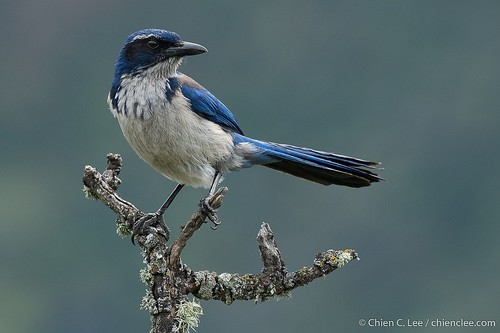
The island scrub jay (scientific name Aphelocoma insularis Henshaw, 1886) is closely related to the California scrub jay, specifically the coastal population that lives on the adjacent mainland. It differs from the California scrub jay by being larger, having brighter coloration, and a markedly stouter bill. In the fall, island scrub jays bury (cache) acorns to eat months later. Their diet also includes insects, spiders, snakes, lizards, mice, and the eggs and nestlings of other birds.
Today, the island scrub jay is only found on Santa Cruz Island, which is the largest of California's Channel Islands, with an area of 250 km² (96 mi²). The entire island is a nature reserve: the eastern 24% is managed by the National Park Service as part of Channel Islands National Park, and the remaining area is managed by the Nature Conservancy. Fossil remains of island scrub jays have been discovered on Santa Rosa and San Miguel Islands. On Santa Cruz Island, island scrub jays live in oak chaparral and bishop pine (Pinus muricata) woodland. Individuals in pine habitat have longer, shallower bills than those in oak habitat; this bill shape variation is heritable, and individuals mate nonrandomly based on bill morphology.
The Chumash people, original inhabitants of the northern Channel Islands, may have eaten these local scrub jays, or used their feathers for decoration. This is supported by evidence that Chumash people on the Californian mainland made feather bands that included jay feathers. Human activity is thought to have contributed to the presumed extinction of island scrub jays from the smaller Channel Islands.