About Aphantopus hyperantus (Linnaeus, 1758)
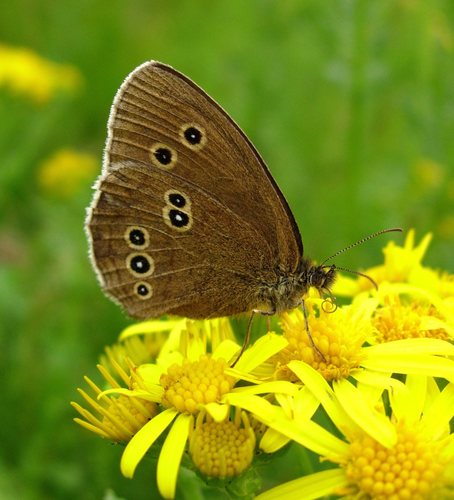
Aphantopus hyperantus (Linnaeus, 1758) is a medium-sized butterfly with a wingspan ranging from 35 to 42 millimeters. Both the upper and lower sides of its wings are solid brown, marked with small eyespots rimmed with yellowish color. Newly emerged ringlet butterflies have a velvety texture, an almost black coloration, and a white fringe along the edges of their wings. The number and size of the species' eyespots are variable, and they may be completely absent from the upper surface of the wings. The rare form arete occurs in central Europe and southern England. When first laid, the eggs of this species are pale yellow, and they fade to pale brown as they develop. Full-grown caterpillars reach approximately 25 millimeters in length. They are colored gray or light reddish brown, covered in very fine dark reddish brown dots. A dark longitudinal line runs along the dorsal side of the caterpillar's body, and this line widens at each segment boundary. The line becomes more intensely colored toward the rear of the body. The caterpillar's head is darker than the body and marked with several faint longitudinal stripes. The ringlet is a widely distributed species found across most of the Palearctic realm. In Europe, it is common in most countries, but it is absent from northern Scandinavia, peninsular Italy (it only occurs in northern Italy), Portugal, southern and central Spain (it is found only in the Cantabrian Mountains and the eastern Pyrenees), Mediterranean islands, and North Africa. In Greece, the ringlet is only found in the northern regions of Macedonia and Thessaly. Outside of Europe, it occurs across much of temperate Asia, including Russia, Siberia, Mongolia, China, and Korea. Ringlets inhabit grassy, moist or dry forest clearings that contain bushes, and they do not live in open areas. They have a strong attachment to woodland edges and blackberry bushes. This butterfly can also be very common in areas with creeping thistles (Cirsium arvense), swamp thistles (Cirsium palustre), oregano (Origanum vulgare), forest scabious (Knautia sylvatica), or hogweed (Heracleum sphondylium), which are the preferred nectar food plants for adult butterflies. Males fly slowly and continuously to search for newly emerged females, fluttering around and between grass stems. Caterpillars of this species feed on many types of grasses. A list of confirmed larval food plants follows.