About Aphanes australis Rydb.
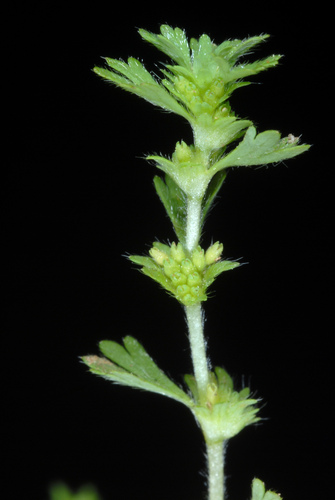
Slender parsley-piert, scientifically named Aphanes australis Rydb., is a pale green winter annual herb. It has prostrate, branched, leafy stems that can grow up to 15 cm long. Its leaves are alternate, arranged in a spiral around the stem, with a short petiole and large, deeply lobed stipules at the base. The leaves are roughly 0.5 cm long, broadly ternate with deeply lobed leaflets, and covered in sparse hairs. A key identification trait is its leaf base, which is usually cuneate, narrowing gradually into the leaf stalk. Inflorescences form glomerules of 4 to 10 flowers that sit nestled within the stipules, opposite the base of each leaf. The flowers reach up to 2 mm long, are pale green, sparsely pubescent, and have 4 sepals that never fully open; petals are absent. The flowers are bisexual, typically bearing a single stamen and a single style, which are almost entirely hidden by the sepals. Each flower produces one ovoid, glabrous, shining achene. Slender parsley-piert can be very hard to distinguish from common parsley-piert, though slender parsley-piert tends to be smaller, a brighter green, has cuneate rather than cordate leaf bases, and grows in acid grassland instead of arable fields and waste ground. These useful field identification traits can be confirmed with additional observations: slender parsley-piert has flowers 1-1.9 mm long, while common parsley-piert flowers are 1.9-2.7 mm long; slender parsley-piert has upright sepals, while common parsley-piert has spreading sepals; slender parsley-piert has smooth fruits, while common parsley-piert has furrows at the base of its fruits; slender parsley-piert has deeply divided stipule teeth, while common parsley-piert's stipules are divided less than halfway; slender parsley-piert has 6-9 leaf lobes, while common parsley-piert has 7-15 leaf lobes. Slender parsley-piert occurs across Western Europe, excluding Mediterranean islands and the former Czechoslovakia, extending east to Turkey and south to North Africa. Although its scientific name originated from an American study, it is now considered an introduced species in North America, where it is found in eastern U.S. states from New York to Texas, and on the west coast from Vancouver Island to Oregon. It is also an introduced species in Australia and New Zealand. It has not yet been assessed for a global threat status, but it is classified as LC (Least Concern) in Britain and France, meaning there is no evidence of population decline. In Britain, the Ellenberg values for slender parsley-piert are L=7, F=4, R=5, N=4, S=0, which indicates it favors moderate light, low moisture, slightly acidic conditions, low nutrients, and is salt intolerant. Its main habitat in Britain is the U1 Festuca ovina community, an upland acid grassland that typically grows on nutrient-poor, acidic soils. It has also been recorded growing on patches of bare soil and sparse vegetation across a variety of other habitats, including CG2 Avenula pratensis, CG3 Bromus erectus and CG7 Festuca ovina grassland, and OV22 Poa annua open vegetation community. The downy mildew Peronospora oblatispora is the only disease known to infect this species. There are no recorded uses for slender parsley-piert, but it is presumed that any uses for common parsley-piert would also apply to this species.