About Apeira syringaria (Linnaeus, 1758)
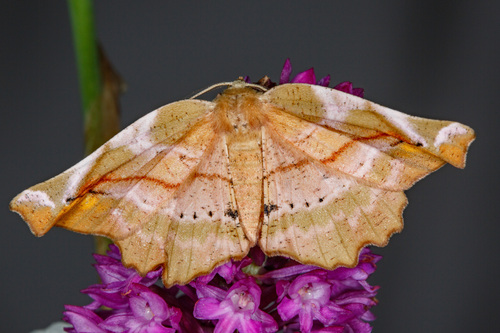
Apeira syringaria, commonly known as the lilac beauty, is a moth species belonging to the family Geometridae. This species is distributed across all of Europe, extending east through the Palearctic region to the Russian Far East and Japan. The moth has a wingspan of 38–42 mm, with forewings measuring 19–22 mm in length. Forewings range in colour from violet-grey to bright reddish brown, with a yellowish marginal field. White markings run along the costa. The inner cross line is pinkish white, and is broken below the costa toward the basal field. A narrow red-brown central band is present, and this band continues onto the hindwings. The outer cross line is dark along the front edge, becoming pink white, and adjoins a dark row of dots on the hind wings. A pink-white spot sits separate from the wing apex. When at rest, the front margins of the wings are distinctly folded. This folding, combined with the moth's colour and pattern, gives it a crumpled leaf-like appearance. Fully grown caterpillars can reach up to 30 mm in length. The seventh abdominal segment bears a prominent pair of curved extensions, while smaller dorsal humps are present on the fifth and sixth segments. Caterpillars are pale ochre in base colour, marked with dark olive-brown or purple-brown patterns, and have a grey-brown head capsule. Unlike most other looper caterpillars, caterpillars of this species do not rest in a stretched position. Instead, they hold a curved shape that resembles the dried fruit capsules of lilac. The adult moth flies from June to July. Caterpillars feed on lilac, honeysuckle, and privet. This species overwinters in the larval stage. It inhabits woodland, heathland, and is occasionally found in fens.