About Apatura iris (Linnaeus, 1758)
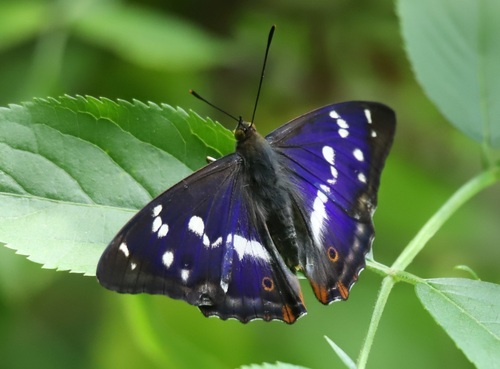
Scientific name: Apatura iris (Linnaeus, 1758). Adult Apatura iris have dark brown wings marked with white bands and spots, and a small orange ring on each hindwing. Males have a wingspan of 70–80 millimetres (2.8–3.1 in), and feature a purple-blue iridescent sheen that the slightly larger females (with an 80–92 mm wingspan) lack. The larvae (caterpillars) are green with white and yellow markings, bearing two large "horns" at the anterior end and one smaller horn at the posterior end. In Seitz's description: A. iris L. (50a) has a violet-blue sheen in males, and is distinguished by the white band of the hindwing, which bears a sharp tooth distally at the anterior median vein; the outer margin of the forewing is only slightly incurved below the apex. Females are larger than males, have somewhat broader wings, are brown, and lack blue gloss. The nymotypical subspecies is individually variable. For example, some males from Hungary have a pure blue gloss instead of violet-blue, or have white markings flushed with rosy red, and the marginal band of the hindwing is cinnamon-brown. Several named aberrations are known: ab. thaumantis Schultz has enlarged and widened white markings; pale spots that are faint elsewhere are larger and sharper, especially at the margin of the hindwing. On the underside of the forewing, russet-red scaling is restricted by the widening of the black markings; on the hindwing, the narrow dark marginal line is absent, and the white median band is more or less shaded with black. So far, only males have been found in the wild, they are rare, and this aberration has also been artificially produced through temperature experiments. ab. jole Schiff. (50b, transition) is the opposite of the preceding: white markings are nearly gone except for the subapical spots of the forewing, which are sometimes also absent, and the entire black wing surface has a blue sheen. It occurs in all transitions toward the main form, and asymmetric specimens have been observed; occasionally there are pale radiating smears in the distal area of the hindwing. It is rare everywhere among the main form, and both sexes are known. ab. lutescens Schultz has only been observed in females: the white bands and spots are shaded with darker or paler brownish yellow; it is likewise rarely found in the wild. Very rarely, females of this species have uppersides irrorated with golden scales, which are more concentrated in the posterior area of the forewing and the anterior area of the hindwing; this form is ab. aurosquamosa Gillm. The nymotypical subspecies, including its aberrations, is distributed across Central Europe, Southern England, and southward to Spain, North Italy, Dalmatia, Roumania, Bosnia; it is also found in Asiatic Russia and Asia Minor (Amasia). Eggs are cylindrical, ribbed, and yellowish or greenish with a slight red tinge. Larvae feed on Salix caprea (sallow), Salix cinerea and Salix aurita. Young larvae are brown and slug-like; after the first moult, two horns appear on the head, and the colour becomes greenish. Young larvae hibernate on a silk pad on a branch of the food plant near a bud; in spring (May), the third moult occurs. After moulting, the body becomes leaf-green with yellow dots and side-stripes on the anterior segments; the head is blue-green with red mandibles and white stripes; the horns are green, blue on the anterior side, edged with yellow laterally, reddish at the lip, and forked; there are two reddish anal processes. Pupation occurs at the end of May or in June. The pupa is compressed, and is bluish green or whitish; the head has two projections, and the abdomen has yellowish oblique stripes. The pupal stage lasts approximately 2 weeks. Adult butterflies occur at the edge of and within leafy woods. In the early morning they can be found drinking on dewy woodland roads and at puddles; they become more restless later in the day, fly at a considerable height, are attracted to foul-smelling matter (excrements, dung, urine, cheese) and are easily lured with these baits. Their flight is strong and graceful. Butterflies rest with wings spread on the leaves of trees or shrubs, and like the preceding related species, they have the habit of returning to their resting place or nearby if disturbed. Females rarely descend to the ground, and generally remain in the tree tops. In Amurland, brownish bands and spots are standard in females (similar to ab. lutescens); males are especially large, the wing ground colour is less dark, and the sheen is stronger and a lighter reddish blue. This is a local form, described as the new subspecies Apatura iris amurensis. In bieti Oberth., markings are brownish yellow in males, and match the European form in shape and position; however, the blackish spot in the anal area of the forewing is eye-like, with a blue pupil, the eye-spot of the hindwing is enlarged, and this wing bears two additional brownish transverse bands in the distal area. In females, markings are yellowish, except for the white subapical spots of the forewing. This subspecies is found in Tibet, West and Central China, flying in June and July, up to about 3000 m elevation. Alongside this brown main form, a form with white spots in both sexes flies in the same regions; it is much larger than the European race, and has a deeper chocolate-brown underside. It is similar to the Amur form, and is described as the new form recidiva. In females of this form, a dull ochreous marginal band is usually still visible on the hindwing. Apatura iris is widely distributed in dense, broadleaved woodlands throughout Europe including southern Britain, and across the Palearctic to central and western China. Different subspecies are found across the region. For the life cycle: Adults lay eggs in late summer on the upperside of sallow leaves. They prefer the broad-leaved sallow Salix caprea, but will also use the narrow-leaved sallow Salix atrocinerea and various species of poplar. Poplar is a more common food plant in continental Europe than in the British Isles. After hatching, larvae rest along the midrib of the leaf, where they are well camouflaged, and feed only at night. During the winter, they hibernate in the forks of sallow branches, where they change colour from green to brown to match their surroundings. Fully fed larvae have been reported to reach lengths of either 35–40 mm or 55–56 mm; definitive measurements are hard to obtain because larvae lack a rigid structure. The following June, they form a pale green chrysalis 30–35 mm long and 12–15 mm wide, which resembles a leaf shoot. Adults usually emerge in July and fly through most of August.