About Apatura ilia (Denis & Schiffermüller), 1775
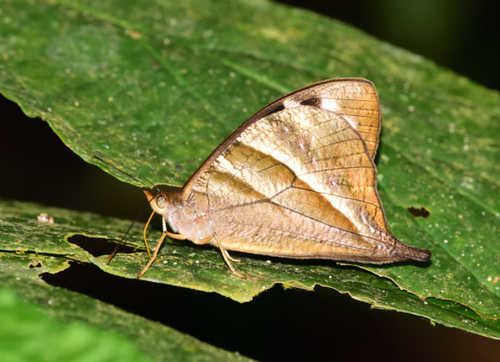
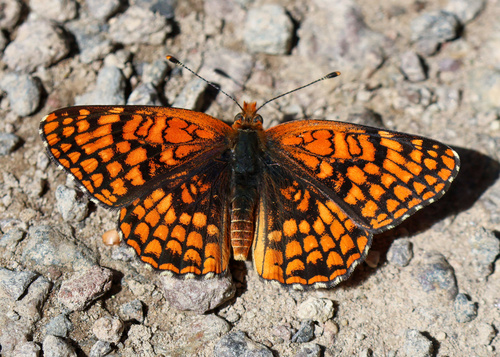
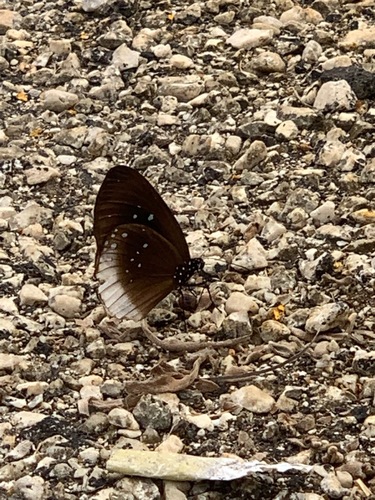
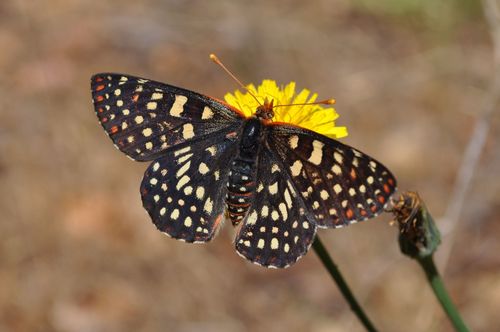
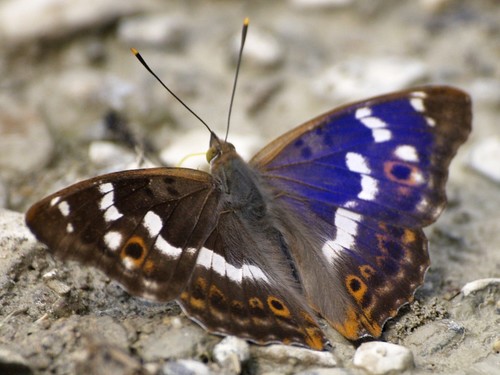
This species, Apatura ilia (Denis & Schiffermüller), 1775, has a wingspan of 55–60 mm (2.2–2.4 in) in females and 60–70 mm (2.4–2.8 in) in males. The upper side of the wings is dark brown. Males show metallic blue-violet hues, and the wings have a clear postdiscal band on the hind wing and several light spots on the fore wing. These light markings have two common color forms: they are white in the nominal ilia form, and clear fawn in the clytie form. Both forms have an orange ocellus on the fore wing, which helps distinguish this species from Apatura iris. A similar ocellus is also present on the hind wing in both A. ilia and A. iris. The underside of the fore wing is brown, and the underside of the hind wing is dull brown with an orange ocellus centered in black, matching the pattern of A. iris. According to Seitz's description of mounted specimens, A. ilia is characterized by the distal margin of the forewing being obtusely angulate below the apex. There is an ocellus ringed with yellowish in the anal area of the forewing, and the median band of the hindwing has no tooth-like projection on its outer side. Males have a violet gloss, while females are dull black-brown or grey-brown; bands and spots are pure white in both sexes of the nominal form. The species is very variable in color and pattern, and males may sometimes have a pure blue sheen instead of violet, similar to Apatura iris. Multiple named aberrations and forms are recorded: ab. iliona Schultz, 1904 is a rare female form with normally developed markings that have a yellowish tint, and no marginal spots on the hindwing; ab. distincta Schultz, 1904 has the hindwing band separated into isolated spots by broad ground-colour vein streaks; ab. pallescens Schultz, 1904 refers to paler specimens of both sexes with pale ashy-grey ground colour, weak gloss in males, and a paler yellow-tinted underside – most are thought to be artificial products of temperature experiments, though some are occasionally found in the wild; ab. inspersa Schultz has bands and spots on both wings shaded with sooty-black, without the markings disappearing or becoming diffuse; ab. iliades Mitis, 1899 is black with almost no markings, at most retaining white subapical spots on the forewing, and males have a blue sheen – this form occurs alongside the main form across its range, with males more commonly affected than females, and both extreme forms and intergrades are found; ab. asta Schultz, 1904 appears in otherwise normal specimens, with yellowish spots in the anal angle of the forewing, a brownish macular band at the hindwing margin, and brownish smears between this band and the white median band; it somewhat resembles Apatura metis bunea; ab. magnifica Schultz, 1904 has a broad yellow margin traversed by black veins. The type male has other white markings heavily shaded sooty-black as in ab. inspersa. A female variant of this form has ivory-coloured spots and median bands on a very dark ground, and a broad brownish outer margin on the hindwing. It is rare in nature, and is also known as a product of temperature experiments; ab. clytie (currently treated as ilia ssp. clytie [Denis & Schiffermüller], 1775) is the form where all normally occurring markings except the forewing subapical spots are brownish, and the hindwing has a brownish entire or macular submarginal band. It occurs alongside the main form everywhere, with ground colour varying between lighter and darker tints in transitions to the main form. In southern parts of the species' range, this brown form is locally dominant or the only form, merging into named brown subspecies; ab. astasioides Staudinger, 1871 has the brown bands and spots of the upperside entirely or nearly absent, holding the same position among clytie that ab. iliades holds among nominal ilia, and occurs occasionally with the main form; ab. phryne Aigner is a transitional form towards ab. astasioides, with reddish brown and vestigial markings in the forewing central area, and on the hindwing's submarginal macular band and median band. It has been recorded from Hungary, and occurs alongside clytie in other countries as well. Fully grown larvae of this species measure 4–5 cm long, and are dirty green. They are similar in shape and markings to larvae of A. iris, but differ in having reddish horns on the head marked with a black stripe, two red-edged yellow lines on the anterior body, and 5 red-margined yellow oblique stripes (each extending across 2 segments) on each side of the body from the center backwards. Anal processes and legs are blue-green. Larval habits are similar to those of A. iris, and larvae feed particularly on Populus tremida, P. pyramidalis, and various willows including Salix caprea, S. viminalis and S. rosmarinifolia. The pupa is greenish, with a keeled (carinate) dorsal surface; the back, wing-cases, and head processes are edged with yellow. Adult butterfly habits are similar to those of A. iris. The nominotypical subspecies, including the individual forms listed above, is distributed across Germany, Belgium, France, Switzerland, Austria, Bosnia, Serbia, western and northern Hungary, Finland, the Baltic Provinces of Russia, and South Russia (Volga districts). As noted, the white-marked nominal form becomes less common in southern districts of West and Central Europe, where brown specimens are the dominant or only form, sometimes forming distinct local subspecies. A notable exception to this southern trend is a white-spotted subspecies found in Portugal, A. ilia ssp. lusitanica Stichel, 1908, which differs very little from northern forms, and is distinguished by enlarged white spots near the forewing ocellus, and a row of small brownish spots between the whitish submarginal spots and median band on the hindwing, similar to ab. asta. Two named brown subspecies are recognized: ilia ssp. eos Rossi, 1794, found in Southern France (Provence) and Northern Italy, which has a paler dark ground colour dusted and shaded with brown (especially at the wing base), almost no remaining violet gloss, dilated and sometimes poorly defined ochre-yellow markings, and a row of roundish black-brown spots shading proximally near the light submarginal band on the hindwing; and ilia ssp. budensis Fuchs, 1899, which is similar to eos but lacks any blue gloss entirely, has a bright yellow basal area on the hindwing, and the dark wing border usually present in clytie is sometimes absent or replaced by a heavy brown-grey arched stripe. This subspecies is found in Hungary, especially south and east of Budapest, becomes less constant and distinct further north (where it intergrades with clytie and sometimes approaches eos in coloration), also occurs in Bulgaria and the Bukovina, and is sometimes incorrectly treated as identical to Apatura metis. A further subspecies, A. ilia here C. & R. Felder, 1862 found in Eastern Central and North China (records from Japan are considered erroneous, and identical darker specimens also occur in West China, the Shan-States, and Upper Burma), has even lighter wing colour: males have a weak violet sheen on remaining dark areas, which becomes a brilliant red-violet gloss when viewed at an acute angle. The hindwing median band is sometimes so broadly dilated towards the distal margin that it joins the submarginal band to form a deep ochre-yellow area holding a row of isolated rounded dark spots, with faint dark shadows extending basad from these spots. In some individuals, especially females, the median band is separated from the submarginal band by a grey-brown area, and the submarginal band is very broad and fully continuous. A distinct female variant of this subspecies, female-ab. sobrina Wileman, 1915, has whitish bands and spots, a light ochreous wing ground with only sparse blackish shading, and reduced small isolated roundish dark spots on the hindwing. Another subspecies, A. ilia ssp. serarum Oberthür, 1891, found in West China (Ta-tsien-lu, Omei-shan, etc.), Central China (Chang-yang), and Yunnan, has a dark ground colour that is shot with deep blue in males, white markings, broadened bands that are straight on the hindwing with sharp edges on both sides, and a row of small whitish submarginal spots on the hindwing; females have a paler ground colour with no gloss. Darker specimens with whitish or partially whitish markings that approach serarum also occur alongside the yellow main form of here in West China, Shan-States and Upper Burma. A distinct form found in southernmost Russia, metis Frr., which is treated either as a full species or a subspecies of A. ilia, is characterized by the loss of ocelli in the anal area of both fore- and hindwing, and a more sharply defined hindwing band that retains its original width. This form is slightly smaller than typical A. ilia, has more sharply angled wings, and all markings are ochreous as in clytie and more or less extended. The hindwing ocellus-like spot is sometimes entirely absent, and the forewing ocellus is usually reduced to a dot. Females are paler, with more or less extensive yellow dusting. Three additional forms related to metis are recognized: ab. bunea H.-Schiff., 1844/4, which occurs alongside the main metis form, where only the hindwing submarginal band and certain outer forewing spots are golden yellow, while central area markings remain white, and this form appears to occur only in males; gertraudis Stichel, 1908, treated as either a full species or a form of bunea, corresponds to the main white-marked ilia form, with only a row of faint obsolescent whitish spots on the hindwing margin. It is easily distinguished from typical ilia by its even-width sharply defined hindwing band and reduced anal ocelli; females have a more or less dark ground, sometimes almost ashy grey, with diffuse markings; coelestina Gr.-Grsh., which refers to male metis with a stronger delicate sky-blue (rather than violet) gloss on the upperside, and a broadened light marginal band on the hindwing that extends to and joins the spots it contains, found in South-East Russia (Sarepta), the Caucasus, and the Altai. In Japan, the A. ilia group is represented by substituta Butler, 1873 (currently treated as a subspecies of A. metis), which is very similar to metis and often confused with it. This form generally has a darker ground colour, the eye-like spots of both wings are not reduced, hindwing submarginal spots are elongate-ovate or rounded-quadrate rather than arrowhead-shaped or luniform as in metis, and the hindwing band on the underside is more distinctly white and contrasts more clearly with the ground. Some specimens from Korea have whitish bands on the upperside, resembling bunea. Observations of this Japanese race note that butterflies circle around the tops of tall willows (the host of their larvae), occasionally descend to damp road patches, or rest on willow leaves. The green pupa is similar in shape and colour to a young willow leaf. This form varies in colour depth, and is more abundant in mountains than in plains. It occurs around Tokio, on Asamayama and Oyama, in Hokkaido, and is also recorded from North China, Korea, the Amur region, Askold, Suifun, and Su-chan. Overall, Apatura ilia is present across most of Europe and through the Palearctic to Japan. It is absent from European Mediterranean islands, southernmost European regions, most of Spain and Portugal, southern Italy, Greece, the Nordic countries of Denmark, Sweden, Norway, Poland, northern Germany, and the British Isles. This species was one of 35 European butterflies with sufficient data for ecologists to study potential range shifts in Europe. Among these 35 species, A. ilia was unique: it is the only species where the northern limit of its range has shifted slightly south, while its southern range limit has remained stable.