About Apamea unanimis (Hübner, 1813)
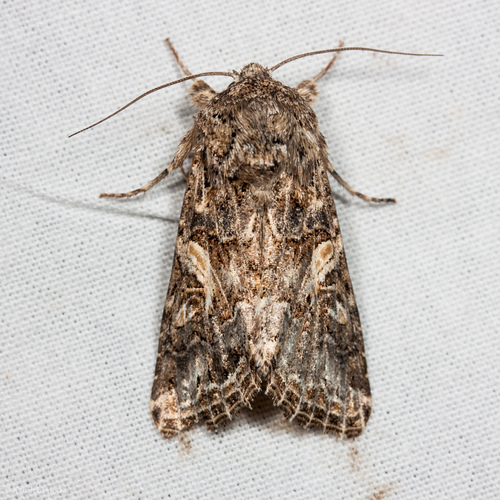
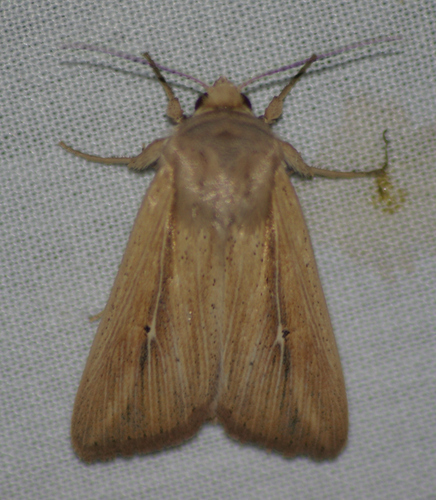
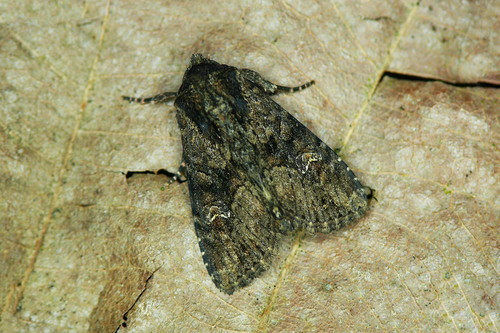
Apamea unanimis, commonly called the small clouded brindle, is a moth species belonging to the family Noctuidae. It was first formally described by Jacob Hübner in 1813. Its native range covers Europe, Turkey, Azerbaijan, and western Siberia. It has been introduced to North America, where it is now found in the Canadian provinces of Ontario, Quebec, and New Brunswick, and the U.S. states of New York, Michigan, and Wisconsin. This moth has a wingspan of 30 to 38 mm. Its forewings are brownish fuscous, or red brown like the form obscura Haw., but carry less grey tinge. There is a black streak below the cell from the base, and another near the base above the inner margin; these are distinct in the aberrations submissa and remissa, but are not visible in typical obscura. A blackish streak on the submedian fold between the two lines is often present. The reniform stigma has a white outer edge. The terminal area is less dark, with more grey dusting. The submarginal line does not form an acute angle below the middle. The form with a black streak on the submedian fold, which sometimes has paler basal and submarginal areas like remissa Hbn, is known as ab. secalina Haw. Ab. rufithorax ab. nov. [Warren], which matches secalina in the traits mentioned above, additionally has the entire head and thorax, including the patagia, bright rufous. Only one male specimen of this form has been collected, from Wiesbaden. Two more forms are notable: ab. fasciata ab. nov. has the median area filled with dark fuscous, making the pale upper stigmata and the inner and outer lines more visible, with blackish head and thorax. Ab. semiochrea ab. nov. [Warren] has pale ochreous postmedian area between the outer and submarginal lines and pale ochreous lower median area, and could easily be mistaken for a specimen of secalis L. ab. oculea Guen. Mature larvae range from reddish clay-yellow to yellow-brown. They have yellow-white dorsal and dorsolateral lines, plus a bright side stripe from which the black spiracles stand out. The head capsule, neck shield, and anus shield are brownish. Adults are active on the wing from June to July, with the exact timing varying by location. The larvae feed on common reed, canarygrasses, and mannagrasses.