About Apamea anceps (Denis & Schiffermüller), 1775
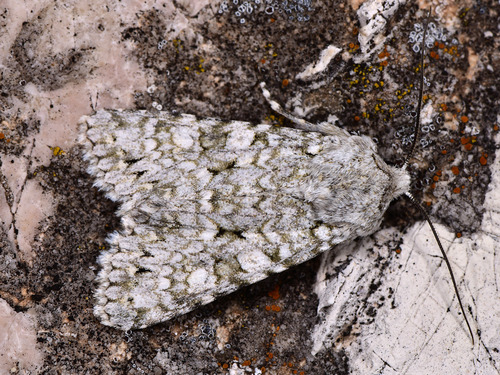
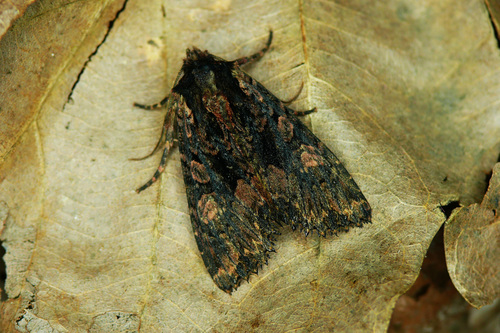
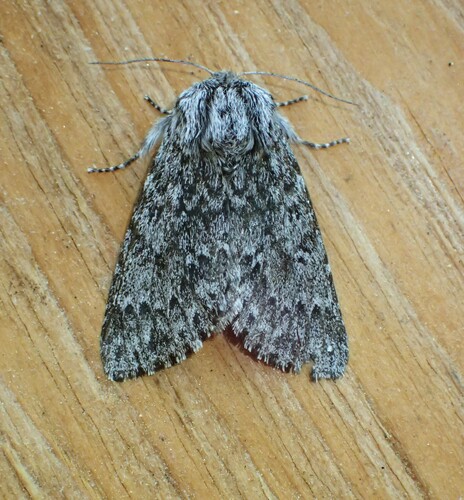
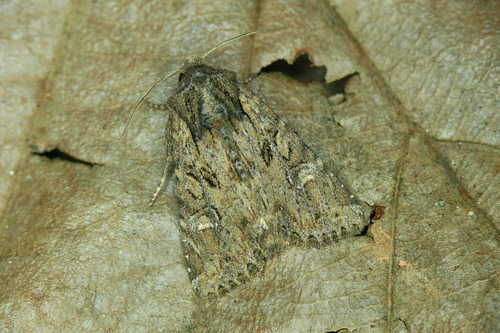
Apamea anceps, the large nutmeg, has a wingspan of 35–40 mm. Its forewings are grey, speckled with darker color, and more or less tinged with brown, with dark veins. The inner and outer lines are double, dark, and filled with the pale ground color; they are conversely lunulate-dentate. The inner line sometimes forms a sharp outward angle below vein 1, meeting the median line, and is sometimes rounded and remote from it. The claviform marking is brown with a darker edge, variable in size, and often quite small. The orbicular and reniform markings are pale with dark centers; the reniform marking has a white dotted annulus and is often followed by a pale patch. Beyond the pale submarginal line, the marginal area is dark grey; this submarginal line is preceded by brownish patches at the costa and on both folds. The hindwing is dirty whitish, with a darker cellspot, darker veins, and a darker outer line. The terminal area is diffusely fuscous, and the submarginal line appears paler along the termen. Several named forms vary in color and patterning: in the typical sordida form, brown tints are confined to the two folds; in anceps Hbn., brown tints more or less pervade the entire forewing; ochracea Tutt has a paler ground color and more rufous brown suffusion; renardii Bsd. is a very pale form with nearly indistinct, subobsolete markings; engelhartii Duurloo is a pale form matching renardii from eastern Jutland with indistinct markings. The aberrant form mediana ab. nov. [Warren] appears very distinct: it has a brown-grey ground color without dark speckling; the inner and outer lines are single, black, and distinct, with the outer line bearing clear black teeth on the veins; the generally inconspicuous median shade is thick and black, distinctly angled outwards on the subcostal vein and veins 1 and 2; the space between the median shade and outer line is deeper brown; the hindwing markings are clearer. This form is known from a single male specimen collected in Germany with no more precise locality information. Adult Apamea anceps are active on the wing from June to July. This species is distributed across all of Europe, and extends through the Palearctic realm to Yakutia, Transbaikalia, Lebanon, Armenia, Asia Minor, Iran, Mongolia, eastern Siberia, the Chinese province of Shaanxi, and Japan. It also occurs in North West Africa.