About Antitype chi Linnaeus, 1758
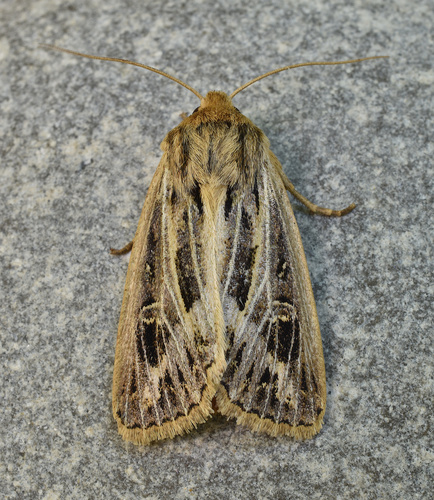
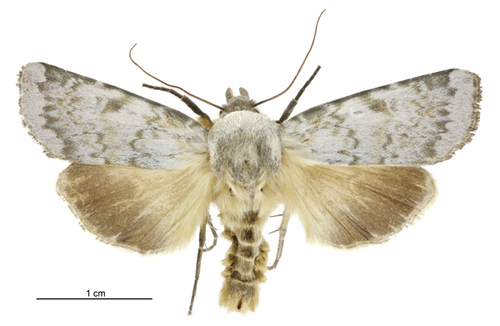
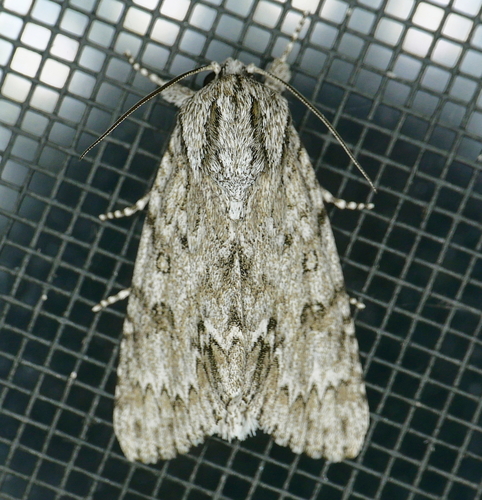
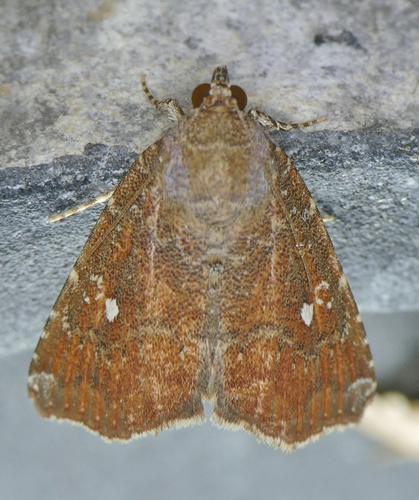
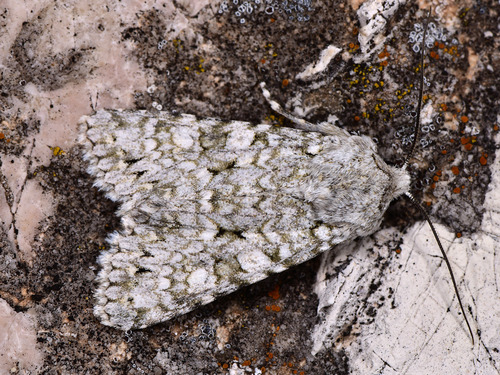
Technical description and variation of A. chi L. (33 i, 34 a): Forewings are chalk white and speckled with grey; the lines are double and grey; the median area is darker, while the stigmata are pale grey and conspicuous; the claviform spot at its extremity is edged with black, and connected by a black dash to the inner darker arm of the outer line; the submarginal line is made up of whitish spots, preceded by black wedge-shaped marks. Male hindwings are white with an interrupted grey submarginal band; female hindwings are blackish grey, with a darker cell spot, veins, and outer line; females are always darker grey than males. The olivacea Stph. (34 a) form from Scotland is suffused all over with olive grey. The subcaerulea Graes. form from N. E. Amurland has dark bluish grey forewings. The suitusa Robson is a dark grey form from the North of England, in which males are just as dark as females. An extreme local development of this form from the area around Huddersfield, Yorkshire, ab. nigrescens Tutt, is nearly black. ab. langei Harrison (34 a) resembles olivacea, but lacks the submarginal line, and the black marks that precede it are wholly or nearly absent. The larva is green, finely dotted with yellow; dorsal and subdorsal lines are whitish; the spiracular line is yellowish white, with diffuse dark green above it. Recorded food plants are: Artemisia (mugwort), Convallaria (lily-of-the-valley), Helianthus (Jerusalem artichoke), Lactuca (lettuce), Lathyrus (meadow vetchling), Lychnis (campion), Ribes (blackcurrant), Rumex, Salix (willow), Saxifraga (saxifrage), Sedum (stonecrop), Silene (campion), Sonchus (sow thistle), Taraxacum (dandelion), Triglochin, Urtica (stinging nettle), and Viburnum (guelder rose).