About Antidesma japonicum Siebold & Zucc.
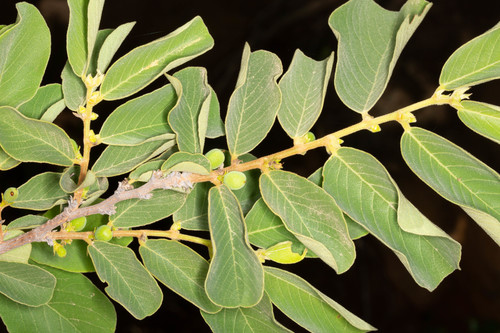
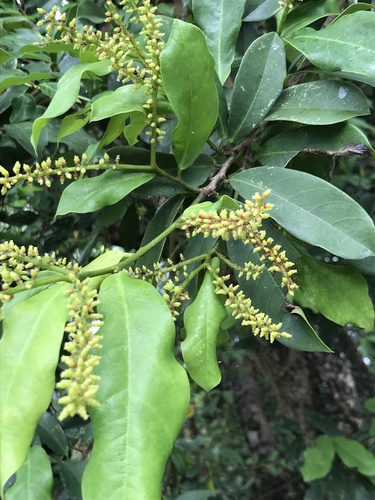
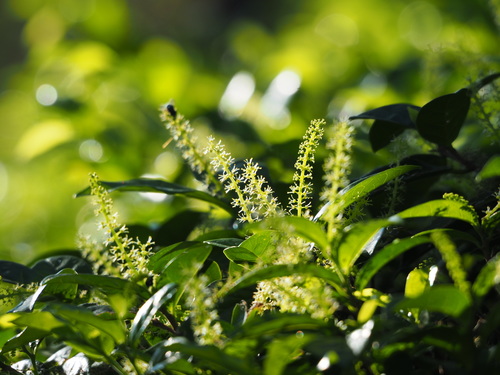
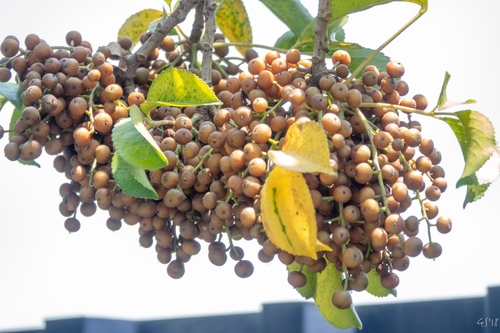
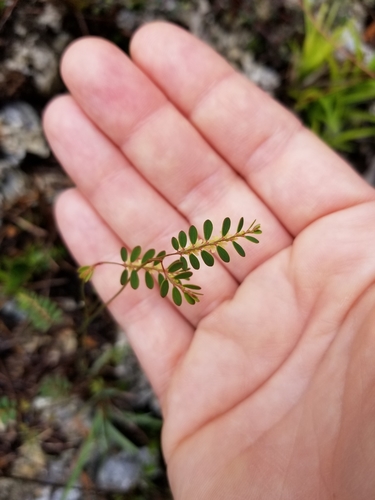
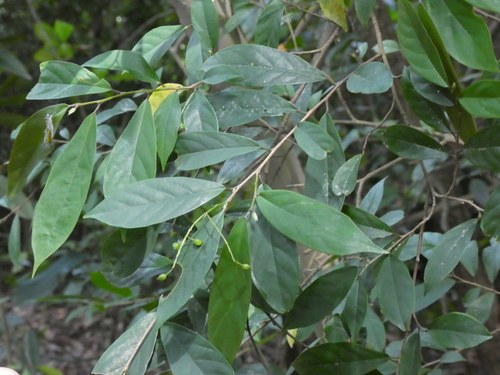
Antidesma japonicum Siebold & Zucc. has two accepted varieties. The nominate variety grows as a 2 to 8 m tall shrub or small tree in China; in Cambodia, it is recorded as a 1–2 m tall winding shrub. Its leaves are light olive to greyish-green, with shapes including elliptic, oblong-elliptic, oblong-lanceolate, and obovate, and measure 3.5–13 cm long by 1.5–4.5 cm wide. Inflorescences grow either terminally or axillary. The fruits are laterally compressed ellipsoid drupes, 5–6 mm by 4–6 mm in size. This variety flowers from April to August, and fruits from June to September.
Antidesma japonicum var. robustius is endemic to eastern Thailand. It differs most clearly from the nominate variety in that its leaf midrib is distinctly raised on the adaxial, upper surface of the leaf. It grows in Dry Evergreen Forest formations in Pak Thong Chai District, Nakhon Ratchasima Province, Thailand, at elevations between 350 and 500 m, and is classified as Rare globally within Thailand.
The nominate variety grows in open forests in humid valleys of southern and eastern China, at elevations from 300 to 1700 m, and occurs rarely in scrub growing on limestone. In Cambodia, the nominate variety grows in secondary forest formations.
The species' overall distribution includes Peninsular Malaysia, Thailand, Myanmar, China, Japan including Nansei-shoto, Taiwan, the Philippines (Luzon and Mindanao), Vietnam, and Cambodia. Within China, it is found in Tibet, Qinghai, Sichuan, Hubei, Anhui, Jiangsu, Zhejiang, Jiangxi, Fujian, Guangdong, Hunan, Guangxi, Hainan, Guizhou, and Yunnan.
The fruit of Antidesma japonicum is edible. Stems and branches are used as excellent firewood. Among Kuy- and Khmer-speaking people living in shared villages in Stung Treng and Preah Vihear provinces, north-central Cambodia, the tree is used as a source of medicine and food, and included as a component in ritual and magical activities.