About Antidesma bunius (L.) Spreng.
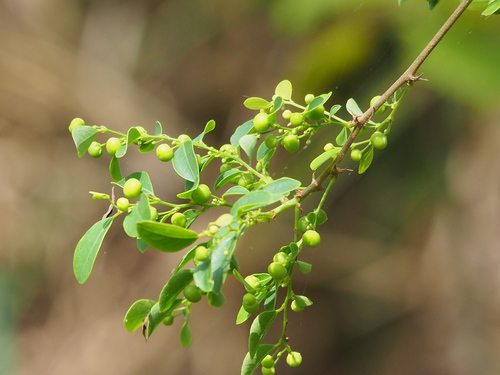
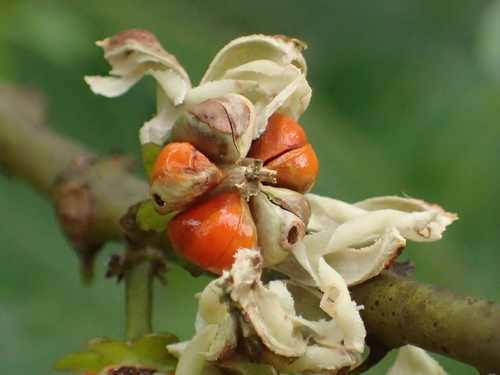
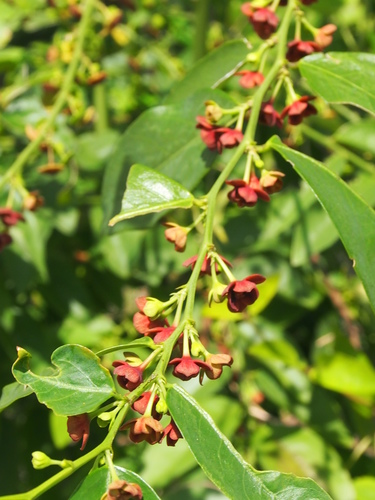
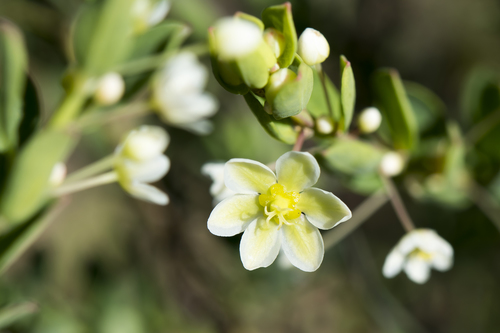
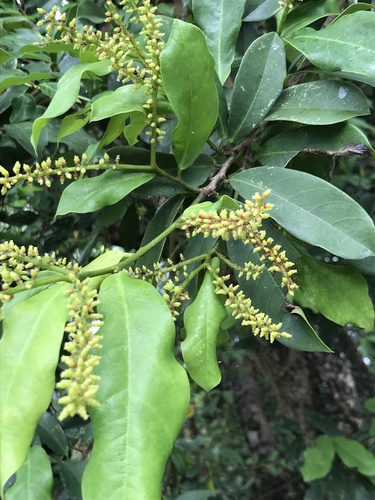
Antidesma bunius (L.) Spreng. is a variable plant, which can be short and shrubby, or tall and erect, reaching almost 30 metres (98 feet) in height. It bears large, oval-shaped, leathery evergreen leaves that grow up to approximately 20 centimetres (8 inches) long and 7 centimetres (3 inches) wide. The leaves attach to the plant’s twigs via short petioles, forming a dense canopy. This species is dioecious, meaning male and female flowers grow on separate individual plants. The flowers have a strong, somewhat unpleasant scent. Staminate (male) flowers grow in small clusters, while pistillate (female) flowers develop on long racemes that eventually become long strands of fruit. The fruits are spherical, measuring just under 1 centimetre (1⁄2 inch) wide, and hang singly or in pairs within long, heavy bunches. When immature, the fruits are white, then gradually turn red, and finally black when fully ripe. Fruits within a single bunch ripen unevenly, so all colors of fruit can be found in one bunch. The fruit’s skin contains red juice, while the white pulp contains colorless juice. Each fruit holds one light-colored seed. Immature fruits have a sour taste similar to cranberries, while ripe fruits have a tart but sweet taste. There is an inverse correlation between the ability to taste phenylthiocarbamide and perceived bitterness in Antidesma bunius. The native range of wild Antidesma bunius extends from parts of South Asia – including Sri Lanka, the lower Himalayan regions of India, and the Andaman and Nicobar Islands – to Southeast Asia including the Philippines, parts of Indonesia, and Mainland Southeast Asia, plus Papua New Guinea, the Solomon Islands, and northern Australia. The species is absent from Peninsular Malaysia and is rare in Borneo. It is cultivated in South Asia, southern China, Southeast Asia, Polynesia, Cuba, Honduras, and Florida. It naturally grows in rainforests and semi-evergreen tropical forests. The fruits of Antidesma bunius are edible raw. Bunches of ripe fruit are commonly sold from village-grown trees in rural Indonesia. In the Philippines, the fruits are used to make bignay wine, jams made alone or mixed with other fruits, desserts, and drinks. Unripe sour fruits are sometimes used as a substitute for tomatoes or vinegar in some Filipino dishes. Tender young leaves are sometimes eaten with rice in Indonesia and the Philippines, and leaf shoots are used to make tea in China.