About Anthoxanthum odoratum L.
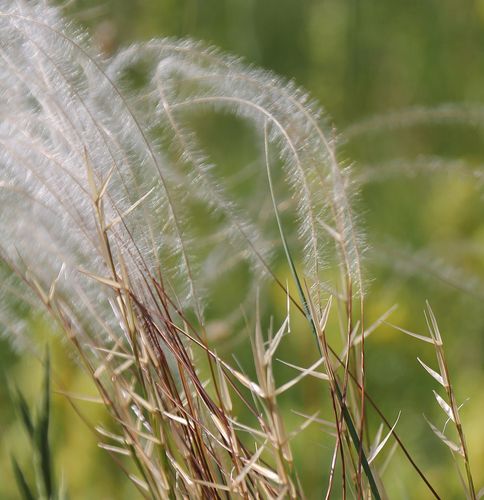
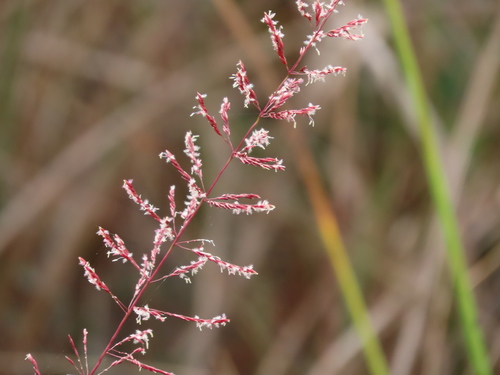
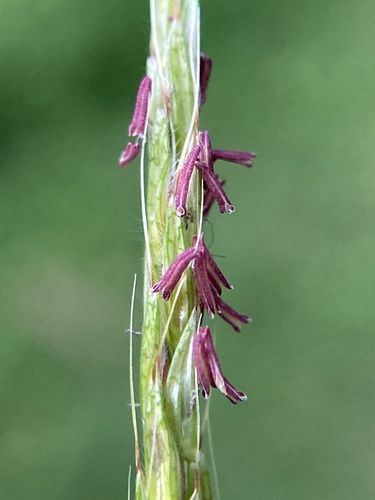
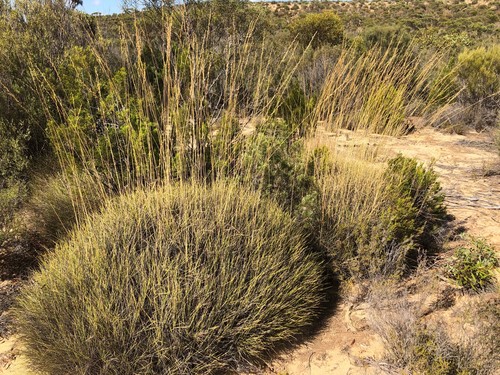
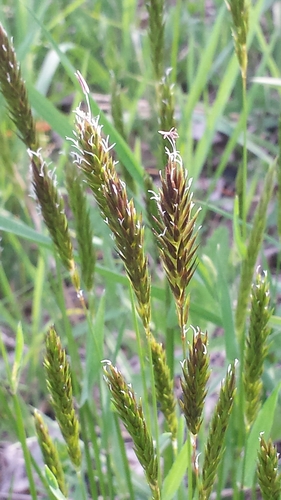
Anthoxanthum odoratum is a short-lived perennial grass that grows in tufts, with stems reaching up to 70 cm (28 in) tall. Its leaves are short and broad, 3–5 mm (0.12–0.20 in) wide, and range from hairless to loosely hairy. It flowers in late spring and early summer, which is quite early in the growing season. It produces flower spikes 4–6 centimetres (1.6–2.4 in) long, holding crowded, oblong-shaped spikelets that are 6–10 mm (0.24–0.39 in) long and often quite dark when young. The lower lemmas have projecting awns. The ligules are fairly long, reaching up to 5 mm (0.20 in), have blunt tips, and bear hairy fringes along their edges. When dried, the grass gives off a particularly strong scent, produced by coumarin (a glycoside) and benzoic acid; the scent is described as like fresh hay with a hint of vanilla. Its seed head is bright yellow in color. In areas with mine contamination, Anthoxanthum odoratum is currently undergoing parapatric speciation. Anthoxanthum odoratum is native to Europe and temperate regions of Asia, but it has been widely introduced and naturalized elsewhere, so its current distribution covers a wide Circumpolar Wide-temperate range. It is found throughout every 10 km square in Britain. For cultivation, seed is scattered across tilled ground from spring through fall, and germinates in 4 to 5 days. It prefers sandy loam and acidic conditions (low pH). When grown as an agricultural grass, it has a low yield, but it can grow on land that is too acidic for other grass species to grow.