About Anthosachne solandri (Steud.) Barkworth & S.W.L.Jacobs
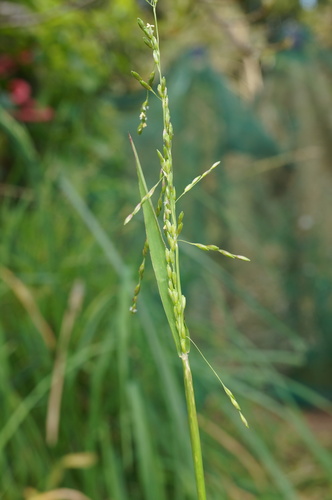
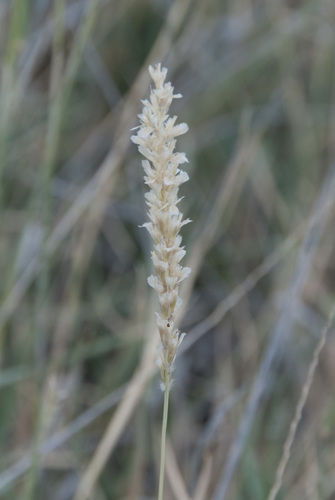
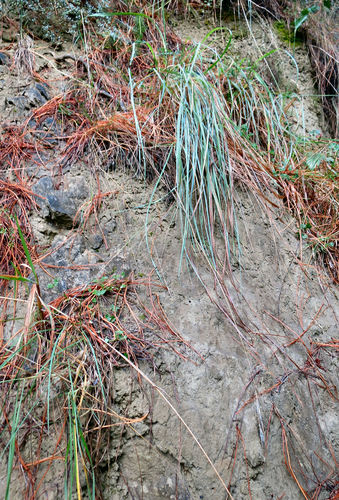
Anthosachne solandri is a medium-sized tufted grass, usually distinctly glaucous, and occasionally green. Its inflorescences hold 3 to 15 spikelets that lie closely against the rachis; each spikelet contains 4 to 10 florets that bear long awns. Along with its closest relative A. scabra, A. solandri can be told apart from other long-awned Anthosachne species in Aotearoa New Zealand by its flat leaves and long, clasping auricles. A. solandri has long been misidentified as the non-native A. scabra. It can be distinguished from A. scabra by its more glaucous, bluish leaves, recurved awns, and pointed, bifid palea apexes. A. solandri is endemic to the North and South Islands of Aotearoa New Zealand. It grows in open habitats: coastal environments, inland tussock grasslands, riverbeds, screes, and moraines, at elevations from 0 to 1500 meters. It has never been found north of Motu Kaikoura, an island off Great Barrier Island. It was first collected on Motu Kaikoura by Thomas Kirk in 1867 (specimen AK 11174), and was presumed extinct there until it was rediscovered by Ewen Cameron in 2006. The type specimen of this species was collected by Joseph Banks and Daniel Solander during Captain James Cook's first voyage to New Zealand aboard the HMS Endeavour. The type locality is "on rocks near Tōtaranui", a site located in what is now the Marlborough Sounds. As an open-habitat species, A. solandri has declined in Marlborough tussock grasslands after grazing was removed, dropping from 12.5% frequency to 4.1%. In the Canterbury and Otago Regions, A. solandri populations increased in response to rabbit control carried out between 1990 and 1995. At Flat Top Hill in Central Otago, A. solandri occurs in plant communities dominated by the invasive species Thymus vulgaris, Rosa rubiginosa, and Sedum acre, and it can grow even within the dense canopies of Thymus vulgaris. At this site, it is also associated with a wide range of other species: the grasses Agrostis capillaris, Anthoxanthum odoratum, Arrhenatherum elatius, Dactylis glomerata, Festuca novae-zelandiae, Festuca rubra, Holcus lanatus, Poa maniototo, Rytidosperma buchananii, Rytidosperma clavatum, Rytidosperma thomsonii, Rytidosperma unarede, and Poa annua; the herbs Acaena novae-zelandiae, Lysimachia arvensis, Crepis capillaris, Helichrysum filicaule, Hypericum perforatum, Hypochaeris radicata, Chaerophyllum ramosum, Pseudognaphalium luteoalbum, Trifolium repens, Trifolium arvense, Verbascum thapsus, Vittadinia australis, and Wahlenbergia albomarginata; the orchids Microtis unifolia and Thelymitra longifolia; the ferns Asplenium flabellifolium and Austroblechnum penna-marina; the liane Muehlenbeckia complexa; and the sedges Carex subtilis and Carex breviculmis.