About Anthosachne scabra (R.Br.) Nevski
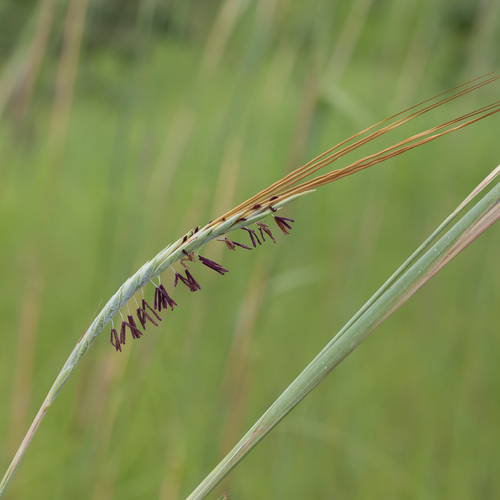
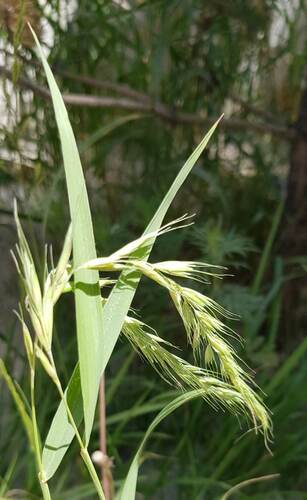
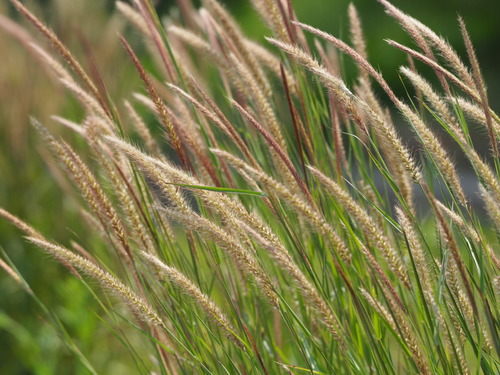
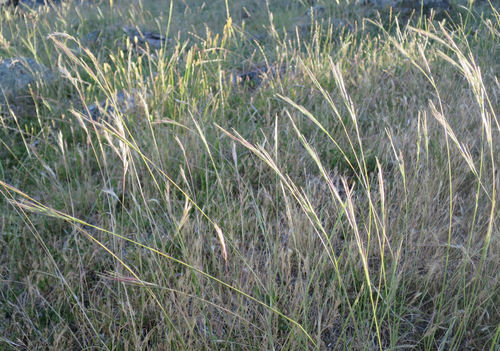
Anthosachne scabra (R.Br.) Nevski is an open, hairy grass species that produces long, drooping inflorescences holding more-or-less straight awned spikelets. It can branch via both intravaginal and extravaginal modes. Its culms are slender, often curved, and grow less than 1.5 m tall. Each culm bears 6–12 spikelets that are 40–55 mm long, or 15–35 mm long when the awn is not included. Each spikelet contains 5–10 florets. The lemma bears a long, scabrid, straight awn that measures 30–50 mm in length. In New Zealand, this species is most similar to Anthosachne solandri. A. scabra can be told apart from A. solandri by its long, slender, curved culms; green, coarsely hirsute leaf blades (instead of glaucous leaf blades); and blunt, truncate to retuse palea apexes (instead of pointed bifid palea apexes). Its awns are typically straight, rather than recurved. A. scabra is endemic to Australia, where it occurs in Queensland, Victoria, Tasmania, South Australia, New South Wales, and Western Australia. In New Zealand, this species was long considered native under the name Elymus rectisetus, but it has more recently been classified as naturalised, likely introduced via imported Australian grass seed. It was probably one of the earliest plant naturalisations in New Zealand, with records of the species dating back to 1843. In New Zealand, A. scabra occurs throughout the North Island, but it is rare in Waikato and Northland. On the South Island, it is widespread, but rare in Westland and Southland, and entirely absent from Fiordland. The type location of the species is not confirmed, but it is thought to be somewhere in Tasmania, most likely between Recherche Bay and D'Entrecasteaux Channel, extending through Storm Bay and the Derwent River estuary to Glenorchy Rivulet. A. scabra grows on well-drained soils, in habitats including rocky areas, poor pastures, waste places, and roadsides. In New Zealand, it can be found from sea level up to 1,250 m above sea level. In Australia, A. scabra includes a number of more-or-less distinctive forms. In Victoria, there are highly glaucous alpine and subalpine forms. In grasslands north and west of Melbourne, a form exists where culms elongate to 2 m long at maturity and become almost prostrate. This form does not have any unique floral characteristics, so it is not formally recognised as a separate taxon.