About Anthophora bimaculata (Panzer, 1798)
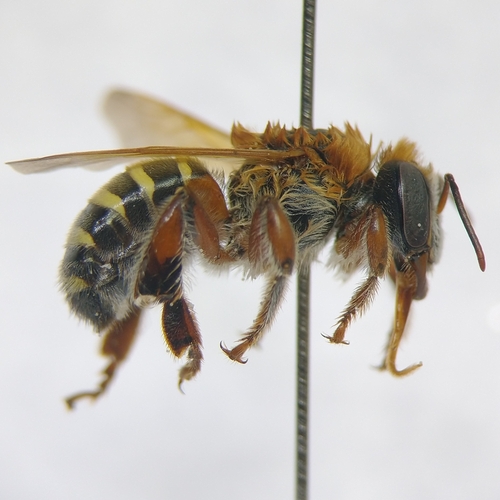
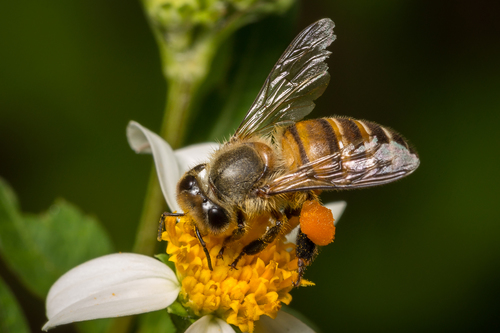
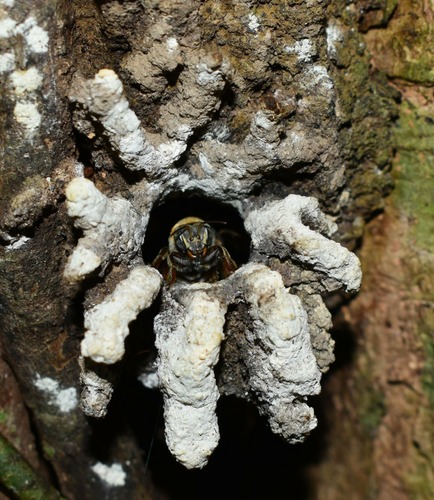
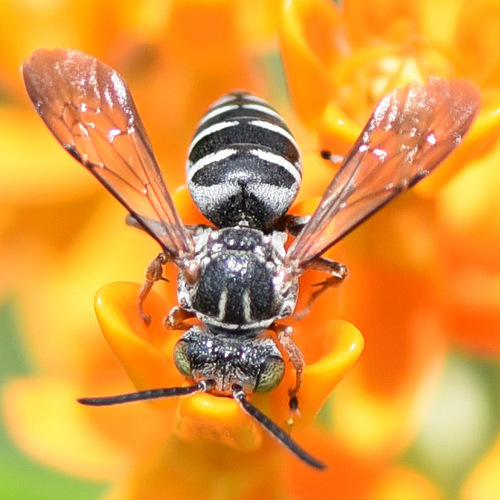
Anthophora bimaculata (Panzer, 1798) adults measure 8–9 mm in length. Males have narrow light-colored bands on their tergites, a yellow face, and clearly visible hairy middle legs that are easy to identify in the field. Females have a yellow clypeus with two large black spots at the base, gray-yellow tomentose hairs on tergites 4 and 5, and light hair bands on their tergites that make them clearly recognizable in the field. Both sexes have olive-green compound eyes and produce a very loud, easily distinguishable flight sound. Knowing the habitat of a specimen is important for identifying this species. Its range includes North Africa from Morocco to Libya; a 1915 report of this species from Eritrea by Friese is considered questionable. It also occurs from Portugal across southern, central, and eastern Europe, through Ukraine and southern Russia to eastern Siberia (Central Baikal), and across Asia Minor and the Caucasus to Iran and Kyrgyzstan. To the north, it reaches Central England; it has allegedly been recently detected in Ireland, and also ranges north to Denmark, Latvia, and Kirov. To the south, it reaches Sicily (it also occurs on Corsica, with no confirmed records from Sardinia), Albania, and Bulgaria; there is no evidence of it occurring in Greece, Israel, or southern Iran. In central Europe, it occupies all regions that provide suitable habitat, and it is generally rare across its range. In Germany, it has been recently recorded across all federal states except Schleswig-Holstein. In Austria, it has been recorded across all federal states except Salzburg, Tyrol, and Vorarlberg. In Switzerland, it is currently found in Graubünden and Valais; historically it occurred around Lake Geneva, Lake Thun, and Lake Biel, as well as in Ticino, Mesox, and Domleschg. A. bimaculata nests in sandy areas at low elevations, including inland dunes, drifting sand fields, sand pits, sandy embankments, ruderal areas, forest edges, and forest clearings. It nests on vegetation-free flat surfaces or on small gentle slopes, and only nests in fine or medium-grained sands such as drifting sand and weathered sand. It digs its own nesting cavities in the ground. Nests have been found in both early succession stages with little vegetation cover and late succession stages with dense vegetation cover, and nests have also been found in the root balls of silver grass clusters. The main tunnel of a nest extends 4–5 cm deep into the ground. Under favorable conditions, this species forms small to large nesting aggregations. A. bimaculata is a polylectic species that collects pollen from 8 known plant families. Confirmed pollen sources are: Centaurea scabiosa, Centaurea stoebe, Cirsium vulgare, Picris hieracioides, and Hypochoeris radicata in the Asteraceae family; Echium vulgare and Anchusa officinalis in Boraginaceae; Trifolium arvense in Campanulaceae; Hypericum perforatum in Hypericaceae; Teucrium scorodonia in Lamiaceae; Lythrum salicaria in Lythraceae; and Potentilla incana in Rosaceae. All of these listed plants serve as nectar sources for both sexes except for the Hypericum species. Individual pollen loads typically contain 3 or 4 different pollen types. Field observations show that flower visits during a pollen-collecting flight follow a random sequence based on local flower availability. The known nest parasites of A. bimaculata are the cuckoo bees Ammobates punctatus and Coelioxys rufescens; in England, Coelioxys elongata has also been observed visiting A. bimaculata nests. This species is univoltine, meaning it produces one brood per year. Its flight period runs from early July to late August, and it overwinters as a dormant larva.