About Anthidium manicatum (Linnaeus, 1758)
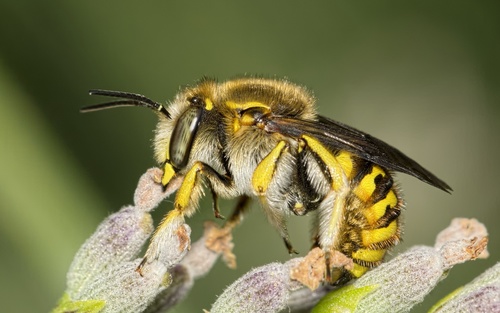
Anthidium manicatum (Linnaeus, 1758) is a bee species originally native to the Old World. Adult bees have a wingspan of approximately 20 millimeters (0.79 in). Females have a body length of 11–13 mm (0.43–0.51 in), while males are 14–17 mm (0.55–0.67 in), making males substantially larger than females. All A. manicatum bees are black and covered with yellow-grey hairs, with yellow spots covering their faces and abdomens. Male A. manicatum have black heads and thoraxes coated in short yellowish-brown hairs. Yellow markings are present on the cheeks below the antennae, a small spot behind each eye, a bilobate spot on the clypeus, and the mandibles (excluding the apex). Their wings are dusky in color. The male abdomen is black with grey hairs, with a band of brown hairs at the apex of each segment and along the segment lateral margins, a feature that distinguishes male A. manicatum from New World Anthidium species. A yellow spot appears on each side of every abdominal segment except the seventh, and a second pair of spots is often visible on the disks of the fourth and fifth segments. A spine occurs on each side of the apex of the sixth and seventh segments, with a third thin spine located in the middle of the seventh segment. Male legs are variegated yellow and covered with grey hairs. Female A. manicatum are smaller than males and share a similar overall color pattern, but their abdominal spots are smaller, and their abdominal apex is rounded. Female legs are almost completely black, with only very small yellow spots. Fine, soft, small white hairs grow on the anterior sides of the tarsal segments of each female leg; this type of pilosity is seen in most Anthidium species native to the Western Palearctic region. Male A. manicatum resemble A. maculosum in appearance; both species have similar spiniform pygidia and largely rounded sixth sterna, though the sixth sternum of A. manicatum is more rounded. A. manicatum is distributed across parts of Europe, Asia, North Africa, and North America. It has recently been recorded in the Canary Islands, and in the South American countries of Argentina, Brazil, Paraguay, and Uruguay. As of 2006, the species is also established in New Zealand. It was accidentally introduced to the United States from Europe before 1963, when it was first discovered in New York. It has since spread from the northeastern United States and southeastern Canada across the country to California, where it was first collected in 2007. The species spreads easily to new locations because it readily occupies ready-made nesting sites, usually on movable objects. In the United Kingdom, A. manicatum is normally found in gardens, fields, and meadows in southern Wales and England, and occurs only in localized populations elsewhere in the country. Active adults can be seen from May to September. This is the only species of the genus Anthidium found in England.