About Anthemis cotula L.
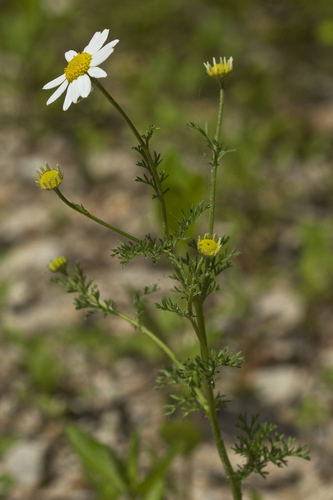
Anthemis cotula L. is commonly called stinking chamomile, named for its resemblance to true chamomile (Anthemis nobilis). Both species have branching upright stems, each topped by a single large flower head. Stinking chamomile can be distinguished from true chamomile by lacking the membranous scales underneath the flowers that true chamomile has, as well as by its characteristic strong odor. Its leaves resemble those of fennel (Foeniculum vulgare), which gives it its other common name, Dog's Fennel. Anthemis cotula is an annual glandular plant with a harsh taste and an acrid smell, growing to a height between 30 and 60 cm (12 and 24 in).
The leaves of Anthemis cotula sometimes bear very fine, soft hairs on their upper surface, though the plant as a whole is mostly hairless. Leaves have no stalk and grow directly from the stems. They are pinnate in shape with many extremely thin lobes, and reach between 25 and 50 mm (1 and 2 in) in length.
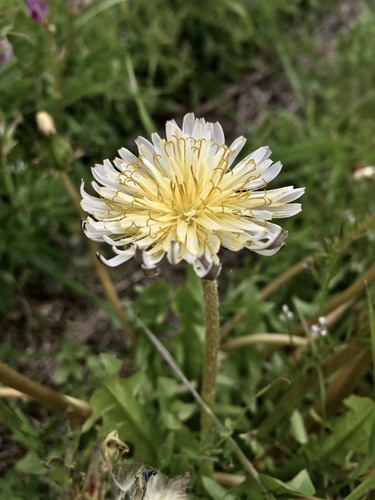
Each stem is topped by a single flower head that is usually around 25 mm (1 in) in diameter. The flower head is surrounded by 10 to 18 white three-toothed ray florets, which tend to curve downwards around the edges of the head. These florets may occasionally have pistils, but these pistils do not produce fruit. Beneath the flower proper, oval bracts form an involucre, and each of these bracts has soft hairs. Additional bristled bracts sit at right angles to the flower.
The fruits of Anthemis cotula are achenes with no pappus. They are wrinkled, ribbed with ten ridges, and have small glandular bumps across their surface.
Anthemis cotula is native to the Palearctic realm, including Macaronesia (Azores, Canary Islands, Madeira), Northern Africa (Algeria, Egypt, Libya, Morocco, Tunisia), and Eurasia: Armenia, Azerbaijan, Kurdistan, Russia, Georgia, India, North Caucasus, Dagestan, Cyprus, Iran, Iraq, Palestine, Lebanon, Syria, Turkey; Eastern Europe (Belarus, Estonia, Latvia, Lithuania, Crimea, Russia, Ukraine, Bulgaria); Northern Europe (Denmark, Norway, Sweden, England, Scotland, Finland); Central Europe (Austria, Czech Republic, Germany, Hungary, Poland, Switzerland); Southern Europe (Albania, Bosnia and Herzegovina, Croatia, Greece, Crete, Italy, North Macedonia, Montenegro, Romania, Serbia, Sicily, Slovenia, Sardinia, Corsica, Portugal, Spain, Balearic Islands); and Western Europe (Belgium, Netherlands, France, Ireland, United Kingdom). It has been introduced and naturalized in the Americas, Southern Africa, and Oceania.
Anthemis cotula is potentially toxic to dogs, cats, horses, and guinea pigs. Reported clinical signs of exposure include contact dermatitis, vomiting, diarrhea, anorexia, and allergic reactions. Long-term use can lead to bleeding tendencies, and the plant's foliage may also cause skin irritation.