About Antennaria plantaginifolia (L.) Hook.
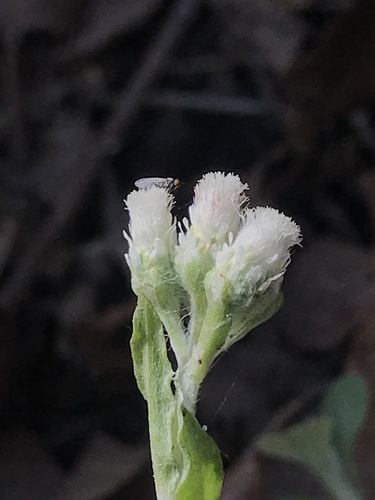
Antennaria plantaginifolia (L.) Hook. rarely grows more than 15 centimeters (5.9 inches) tall. It has a basal rosette and an erect stem that holds the inflorescence, a tight flat-topped cluster of 4 to 17 fuzzy flower heads made up entirely of disc flowers, with no ray flowers. The basal leaves are petiolate, ranging from oval to roundish, 3.5 to 7.5 centimeters (1.4 to 3.0 inches) long and 1.5 to 3.5 centimeters (0.6 to 1.4 inches) wide, with 3 to 7 prominent veins. The underside of the leaves is covered in thick silvery hair. Smaller, lanceolate leaves grow along the stem. The fruits are cypselae with a pappus of white bristles. This species is dioecious, meaning male and female flowers grow on separate individual plants. It often forms colonies, which may sometimes be made up entirely of male or entirely of female plants. This colony formation occurs in part through vegetative reproduction: stolons grow out from the basal rosette, root, and develop into new individual plants. Antennaria plantaginifolia is widely distributed across eastern North America, ranging from Quebec and Nova Scotia west to Minnesota, and south to Mississippi, Arkansas, and Florida, with isolated populations found in eastern Texas and Saskatchewan. In Virginia, it grows in habitats including dry forests, barrens, and meadows. Its survival in any area depends on having appropriate habitat; it can be eliminated from a region by development, changes in land use, or competition with invasive species. In North America, this plant is commonly nicknamed "Indian tobacco", because it was often chewed by children as a substitute for real tobacco.