About Antennaria parvifolia Nutt.
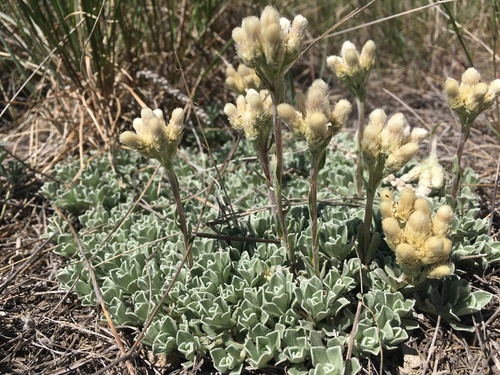
Antennaria parvifolia Nutt., commonly called small-leaf pussytoes, typically grows only a few centimeters tall, though it can reach a maximum height of 15 cm (6 inches). Its grayish leaves are covered in woolly hairs, and grow up to 3.5 cm (1 1/2 inches) long; upper leaves on the stem are shorter and narrower than the plant's basal leaves. The inflorescence holds between 2 and 7 flower heads, each around 1.5 cm (1/2 inch) across, that bloom from July to September. Individual plants of this species are either gynoecious (producing only female flowers) or dioecious (populations contain separate female and male plants). Dioecious populations, which can reproduce sexually, are most common in Colorado and New Mexico, though male plants remain far less common than female plants in these areas. In most other regions where the species grows, plants are mostly gynoecious and reproduce asexually via apomixis. The plant forms low mats by spreading stolons and sprouting new stems. Flower heads are lined with an outer layer of phyllaries that are translucent across most of their surface, with bases that can be white, red, green, or brown. The fruit produced is an achene with a pappus that enables wind dispersal. This species can be distinguished from other members of the genus Antennaria by its clustered basal leaves, and by the near absence of dark bases on the backs of its flower bracts. This species is native to western and central North America, and is widespread across Canada, the United States, and northern Mexico. Its range extends from British Columbia east to Ontario, and south to California, Chihuahua, and Nuevo León. No individuals of this species have been observed in California since 1987. It grows in open, dry habitats including plains and forest openings. In Colorado, this species acts as an indicator of overgrazing, and becomes more frequent on heavily grazed land. It grows well in disturbed habitat, and can tolerate a wide variety of ecosystems and soil types. Some forms of small-leaf pussytoes are regarded as excellent groundcovers, especially by gardeners in the American Great Plains. In more northerly areas such as North Dakota and at higher elevations, these plants prefer to grow in full open sun; in more southerly locations such as Texas or at lower altitudes, they prefer partial shade. They are valued in cultivation for their attractive foliage, early spring flowers, and non-aggressive growth habit even under ideal garden conditions. They require well-drained soil, and can struggle in hot regions when grown in sandy soil. They are cold hardy to USDA zone 4, tolerating temperatures as low as −34 °C.