About Antennaria howellii Greene
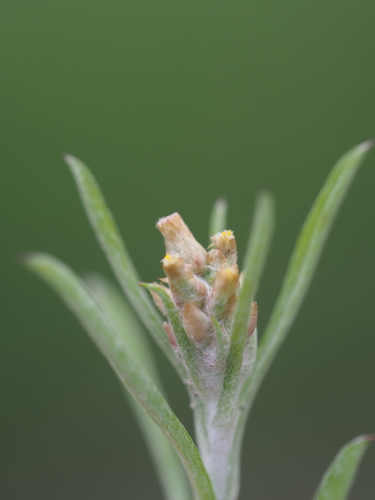
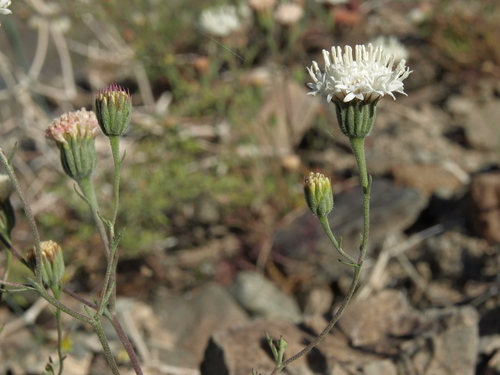
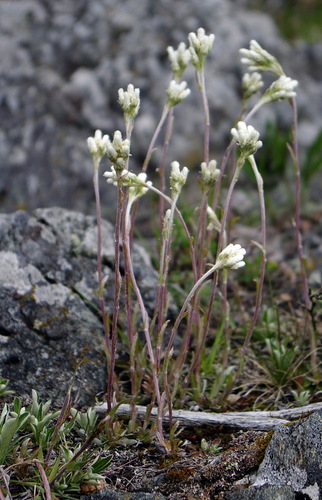
Antennaria howellii, commonly known as everlasting or Howell's pussytoes, is a North American plant species belonging to the Asteraceae family. It is native to northern Alaska, most of Canada (including the country's Arctic territories), and the northern United States, ranging as far south as northern California, Colorado, and North Carolina. This species is an evergreen perennial plant that typically grows in basal rosettes and reproduces largely through clonal propagation. The leaves of the basal rosette measure 2–4 cm long and 6–12 mm wide. They are light green, spatulate in shape, with a narrow base and a broad, pointed tip. Their undersides are covered in white woolly fuzz. Flowerheads emerge in May, growing on a 15–35 cm tall stem that bears smaller, slender leaves 1–4 cm long. Antennaria howellii is commonly found growing under pine stands. Four subspecies are recognized: Antennaria howellii subsp. howellii, found in western and north-central United States, and western and central Canada including Yukon; Antennaria howellii subsp. canadensis, found in northeastern United States, and eastern and central Canada including Labrador; Antennaria howellii subsp. neodioica, found in Canada and the northern United States; and Antennaria howellii subsp. petaloidea, which occurs in Canada and the northern United States. The species is named for American botanist Thomas J. Howell, who collected the first known specimens of the plant in 1887.