About Antennaria alpina (L.) Gaertn.
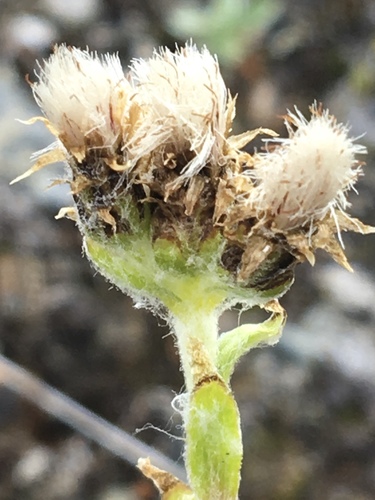
Antennaria alpina (L.) Gaertn. is a perennial herbaceous plant that grows 3 to 18 centimeters tall. It spreads via stolons that measure 1 to 7 centimeters in length. This species is a cushion plant: a compact, low-growing, mat-forming plant with a dense taproot that develops annual growth rings. Basal leaves (leaves attached to the base of the plant) have one prominent vein, and are spatulate to oblanceolate in shape, measuring 6 to 25 millimeters long and 2 to 7 millimeters wide. The upper surface of leaves ranges from green and nearly hairless to gray with abundant hairs, while the leaf undersides are tomentose – white from a thick covering of woolly hairs. Stem-attached leaves are even smaller, narrow like a grass blade, and only 5 to 20 millimeters long. Each stem is topped with two to seven flowering heads that bear somewhat black bracts. Populations in both North America and Scandinavia are mostly gynoecious, meaning they produce almost exclusively seed-producing flowers and rarely produce pollen-bearing flowers. This species is apomictic: it produces asexual seeds that are genetically identical to the parent plant. The involucre (the structure at the base of a flowering head) measures 5–6.5 mm overall, and 4–10 mm for seed-producing flowers. Flowering occurs in mid to late summer. Alpine pussytoes are restricted to alpine and boreal habitats. In Europe, it is native to Norway, Sweden, Finland, and northern parts of European Russia; it grows in the mountains of southern Sweden and Norway, and extends toward the North Sea coast further north. In Asia, it grows in the Magadan Oblast botanical region, which includes the Chukotka Autonomous Okrug at the far eastern tip of Russia. In North America, it occurs in Alaska and the three northern territories of Canada. Further south, it grows in Alberta and British Columbia in western Canada, and in parts of Ontario, Québec, Labrador, and Newfoundland in eastern Canada. In the contiguous United States, it only grows in Montana and Wyoming; the Natural Resources Conservation Service database only records it in six scattered counties in Montana. On Greenland, it is a common plant found as far north as 75°23' N in the west and 74°50' N in the east. It grows at elevations between 100 and 2400 meters, in dry to moist tundra and alpine tundra.