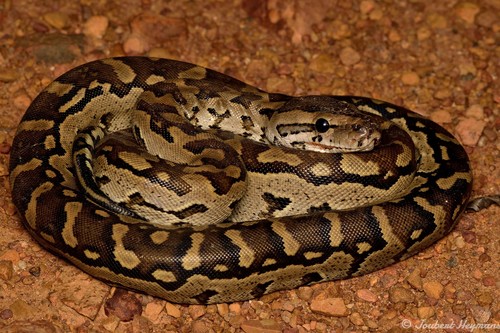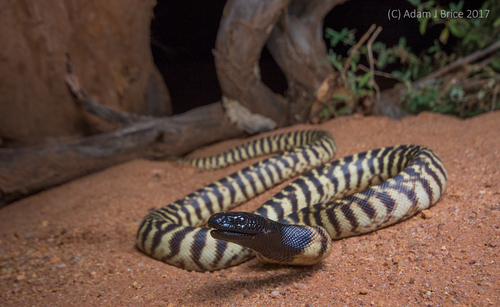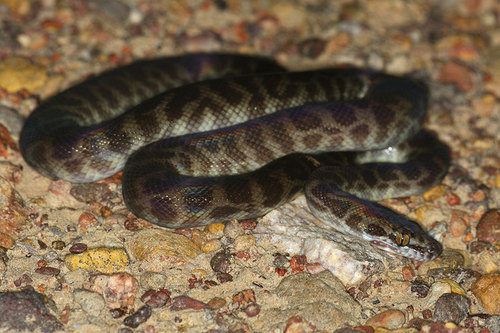
About Antaresia childreni (Gray, 1842)
Adult Size
Adult Antaresia childreni, also known as Children's python, reach a total length (including the tail) of around 1–1.5 m (3–5 ft), with size varying based on location and polymorphic variant.
General Scale Characteristics
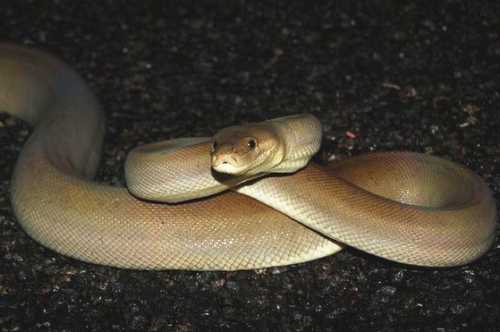
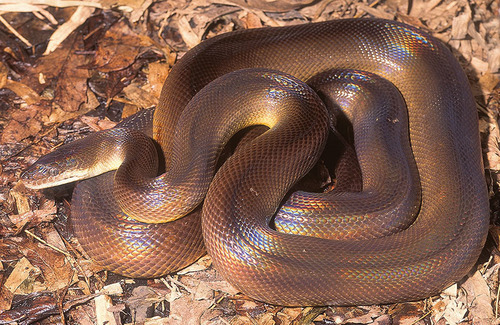
Scales on the top of the head are enlarged, while scales on the upper body are small and smooth, with a visible rainbow sheen when exposed to direct sunlight.
Type Variant Dorsal Coloration
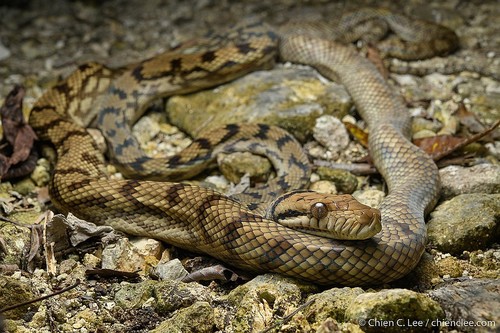
For the type variant, the snake's upper surface is brown, marked with darker spots arranged in five or six longitudinal rows.
Head Markings
A dark streak runs across each side of the head, passing through the eye. The lips are yellowish and spotted with brown, and the lower surface of the snake is uniformly yellowish.
Head Morphology
The head is distinctly separate from the neck. The nostril is located on the upper lateral side, set within a large semidivided nasal scale. The eye is moderate in size, with a vertical pupil.
Body and Tail Shape
The body is slightly laterally compressed, and the tail is short.
Scale Count Details
There are roughly 41 to 45 rows of dorsal scales across the back, 257 to 287 ventral scales along the lower body, a single undivided anal scale just in front of the anus, and 38 to 53 subcaudal scales on the lower surface between the anus and tail tip, arranged all or mostly in two rows.
Stimson's Variant Coloration
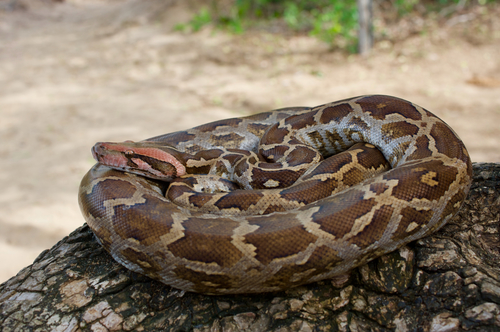
The polymorphic variant commonly called Stimson's python displays much stronger, more variable coloration; it often has reddish-brown to chocolate blotches over a lighter tan base.
Head Scale Morphology
The rostral scale is broader than it is high, and barely visible from above. The internasal scales are slightly longer than broad, and shorter than the anterior prefrontal scales. The second pair of prefrontals either meet at the midline or are separated by a small shield; these posterior prefrontals are sometimes broken into multiple smaller shields.
Frontal and Parietal Scales
The frontal scale is one and a half times as long as it is broad, slightly shorter than the distance from the frontal to the tip of the snout, and longer than the small parietal scales.
Loreal and Labial Scales
There are 3 to 10 small loreal shields, some nearly granular, 11 to 13 upper labial scales, and 3 or 4 posterior lower labials that have deep pits.
Dentition
The anterior teeth of both the maxilla and mandible are very long, and decrease in size gradually toward the back of the jaw. The premaxillary bone also bears teeth.
Species Distribution Range
Antaresia childreni is found in Australia: in the extreme north of Western Australia, the northern third of the Northern Territory, northern Queensland, and the islands of the Torres Strait. It occurs specifically along the coastal region stretching from the Kimberleys in Western Australia to Mount Isa in northwestern Queensland.
Stimson's Variant Range
The Stimson's python polymorphic variant has a much larger range that covers most of inland Australia, from Queensland to Perth.
Type Locality History
The type locality was not specified (marked as "—?") by Gray in the original 1842 description; Boulenger listed it as "N.W. Australia" in his 1893 Catalogue of the Snakes in the British Museum (Natural History) Volume I, and Stimson listed it as "unknown" in 1969.
Habitat Types
Children's python inhabits a wide range of natural habitats, including forest, savanna, shrubland, desert, grassland, and freshwater wetlands.
Parasite Record
In Alice Springs, the generalist tick Amblyomma limbatum has been collected from this python species.
Activity Period
In the Darwin region, data from public reports to professional snake catchers shows that Children's python has a peak activity period in the later part of the wet season, from February to April.
Activity Habitat Preference
During this period, the species is significantly more likely to be encountered in and around open grassland and plains than in other months of the year.
Reproductive Mode
Antaresia childreni is oviparous, with clutches containing up to 25 eggs.
Egg Brooding Behavior
Females brood their eggs over a seven-week incubation period by coiling around the clutch and occasionally shivering to generate heat, which also helps protect the eggs from predators.
Juvenile Coloration
Juvenile pythons are heavily blotched, and gradually become reddish-brown or brown as they mature.
Stimson's Variant Ontogenetic Patterning
As the Stimson's variant matures, it often develops more starkly contrasting patterning, with variation based on locality.
Male Mating Combat Observations
Captive males have been observed fighting over females, which suggests this species fights for mates in the wild, though combat between wild individuals of this species has never been documented.
Combat Behavior Details
When fighting, males use their spurs to scratch opponents, and also strike and bite each other until one individual submits.