About Anseranas semipalmata (Latham, 1798)
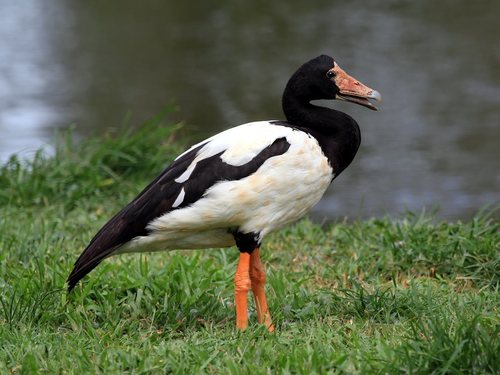
Anseranas semipalmata, commonly called the magpie goose, is an unmistakable bird species with black and white plumage and yellowish legs. Its feet are only partially webbed, and males are larger than females. Unlike true geese, magpie geese molt gradually, so they never go through a flightless period. Their call is a loud honking, and they feed on vegetable matter both in water and on land. Magpie geese live in a variety of open wetland areas including floodplains and swamps, where they wade and swim. Their diet consists mostly of vegetation: dry grass blades, grass seeds, spike rush bulbs, and wild rice. Most populations are fairly sedentary, only making small movements during the dry season. They are colonial breeders, and gregarious outside the breeding season, when they can form large, noisy flocks of up to a few thousand individuals. Magpie geese build their nests either on the ground or in trees up to five meters or higher above ground. Their typical clutch contains between 5 and 14 eggs. Some males mate with two females, and all three adults help raise the young, which differs from what is seen in some other polygamous bird species. This co-parenting arrangement may be beneficial when predation on young is high, as chicks raised by trios have higher survival rates. The species is abundant across its current range, which is significantly smaller than its range at the time of European settlement. Historically, magpie goose range extended as far south as the Coorong, and the wetlands of southeastern South Australia and western Victoria. Across Australia as a whole, the species is not threatened, and it has a controlled hunting season when population numbers are large. However, most southern populations were extirpated in the mid-20th century due to overhunting and habitat destruction. Reintroduction projects for the species have taken place at sites such as Bool Lagoon, located between Penola and Naracoorte. Populations in more northern areas of Australia have recovered to levels where they can be regularly hunted, a sustainable use that does not apply to the reintroduced southern population at Bool Lagoon. Magpie geese were listed as near threatened on the 2007 advisory list of threatened vertebrate fauna in Victoria, and also appear on the December 2007 threatened fauna list created under Victoria’s Flora and Fauna Guarantee Act. As of early 2008, an Action Statement for the recovery and future management of this species had not been completed. With climate change leading to more frequent seawater inundation of the extensive freshwater floodplains that the species relies on, CSIRO scientists have concluded that magpie goose populations may be at future risk.

