About Anser brachyrhynchus Baillon, 1834
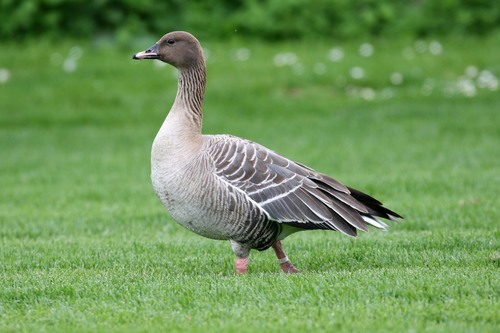
This is the scientific description of Anser brachyrhynchus Baillon, 1834, a medium-sized goose. It measures 60–75 cm (24–30 in) in length, has a wingspan of 135–170 cm (53–67 in), and weighs 1.8–3.4 kg (4.0–7.5 lb). It has a short bill that is bright pink in the middle, with a black base and tip. Its bill color pattern is similar to that of the tundra bean goose, but this species has pink coloring where the tundra bean goose has orange coloring. It also has pink feet. Its body is mid-grey-brown, while its head and neck are a richer, darker brown. Its rump and vent are white, and its tail is grey with a broad white tip. Its upper wing-coverts are a pale bluish-grey, somewhat similar to the upper wing-coverts of the greylag goose, and its flight feathers are blackish-grey.
For its ecology, this goose often nests on cliffs close to glaciers to get protection from mammalian predators, mainly the Arctic fox; it also nests on islets in lakes. Females lay three to six eggs in early to mid-May in Iceland, and in late May in Svalbard. Incubation lasts 26–27 days. After hatching, goslings walk with their parents to the nearest lake, and fledge after about 56 days there. This species migrates south from mid-September to early October, and migrates north from mid-April to early May. Its diet is almost entirely herbivorous. In summer, it feeds on a wide range of tundra plants, both on land and in water. In winter, it grazes primarily on oilseed rape, sugar beet, potato, and various grasses. Grazing by this goose can cause extensive damage to crops, but it can also benefit sugar beet and potato farmers in particular by gleaning leaves and roots left behind after harvest, which reduces transmission of crop diseases from one year to the next.