About Anser anser (Linnaeus, 1758)
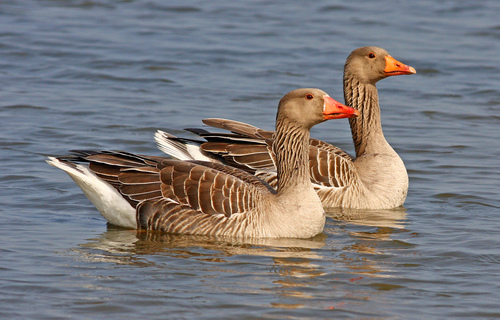
Anser anser, the greylag goose, is the largest and bulkiest of the grey geese in the genus Anser, though it is more lightly built and more agile than its domestic relatives. It has a rotund, bulky body, a thick long neck, and a large head and bill. Its legs and feet are pink, and its bill is orange or pink with a white or brown nail—the hard horny material at the tip of the upper mandible. This species measures 74 to 91 centimetres (29 to 36 in) in total length, with a wing length of 41.2 to 48 centimetres (16+1⁄4 to 19 in), a tail length of 6.2 to 6.9 centimetres (2+7⁄16 to 2+11⁄16 in), a bill length of 6.4 to 6.9 centimetres (2+1⁄2 to 2+11⁄16 in), and a tarsus length of 7.1 to 9.3 centimetres (2+13⁄16 to 3+11⁄16 in). It weighs between 2.16 and 4.56 kilograms (4 lb 12 oz to 10 lb 1 oz), with an average weight of around 3.3 kilograms (7 lb 4 oz), and its wingspan ranges from 147 to 180 centimetres (58 to 71 in). Males are generally larger than females; sexual dimorphism is more pronounced in the eastern subspecies A. a. rubirostris, which is on average larger than the nominate subspecies. The greylag goose's plumage is greyish brown, with a darker head, paler breast and belly that have a variable amount of black spotting. It has a pale grey forewing and rump that are noticeable when the bird is in flight or stretches its wings on the ground. It has a white line bordering its upper flanks, and its light-coloured wing coverts contrast with its darker flight feathers. Pale fringes on individual feathers create a distinct pattern across the plumage. Juveniles differ mostly by lacking black speckling on the breast and belly, and by having greyish legs. Adult greylag geese have a distinctive 'concertina' pattern of folds in the neck feathers. Greylag geese produce a loud cackling call similar to that of domestic geese, rendered as "aahng-ung-ung", which is uttered both on the ground and in flight. There are subtle call variations for different circumstances, and individual greylags can identify other known geese by their voices. The sound made by a whole flock resembles the baying of hounds. Goslings chirp or whistle softly, and adults hiss when threatened or angered. This species has a Palearctic distribution. The nominate subspecies breeds in Iceland, Norway, Sweden, Denmark, Finland, the Baltic States, northern Russia, Poland, eastern Hungary, Romania, Germany and the Netherlands. It also breeds locally in the United Kingdom, Belgium, Austria, the Czech Republic, Slovakia, North Macedonia and some other European countries. The eastern subspecies extends east across a broad stretch of Asia to China. Historically, European greylag geese generally migrated south to overwinter in southern Europe and North Africa, but in recent decades many now overwinter in or near their breeding range, even in Scandinavia. Asian greylags migrate to Azerbaijan, Iran, Pakistan, northern India, Bangladesh and eastward to China. They also occur as very rare winter migrants to South Korea and Japan. In North America, both feral domestic geese similar to greylags and occasional vagrant greylags are present. Wild greylag geese seen in New Zealand most likely originated from escaped farmyard geese; a similar situation has occurred in Australia, where feral populations are now established in eastern and southeastern parts of the country. In their breeding areas, greylag geese are found on moors with scattered lochs, in marshes, fens and peat-bogs, along lakesides, and on small islands some distance out to sea. They prefer dense ground cover including reeds, rushes, heather, bushes and willow thickets. In their wintering areas, they frequent salt marshes, estuaries, freshwater marshes, steppes, flooded fields, bogs, and pasture near lakes, rivers and streams. They also visit agricultural land to feed on winter cereals, rice, beans and other crops; at night they move to shoals and sand-banks on the coast, mud-banks in estuaries, or secluded lakes. Each year, large numbers of immature greylags gather to moult on the Rone Islands near Gotland in the Baltic Sea. Since the 1950s, increasing winter temperatures have led greylag geese to breed across northern and central Europe, reducing their winter migration distances or even becoming fully resident. This allows them to use wintering grounds closer to their breeding range, so they can return to establish breeding territories earlier the following spring. In Great Britain, greylag numbers as a breeding bird had declined, and wild populations retreated north to breed only in the Outer Hebrides and the northern Scottish mainland. However, during the 20th century, feral populations became established elsewhere, and the species has now re-colonised much of England. These populations are increasingly coming into contact and merging. The greylag goose has become a pest species in several areas where its population has grown sharply. In Norway, the greylag goose population is estimated to have increased three- to five-fold between 1995 and 2015. As a result, problems for farmers from goose grazing on farmland have increased considerably, an issue also seen with the pink-footed goose. In the Orkney islands, the population has grown dramatically: from 300 breeding pairs, it increased to 10,000 in 2009, and reached 64,000 in 2019. Due to extensive damage to crops, the hunting season for greylag geese in the Orkney islands now covers most of the year.