About Anser albifrons (Scopoli, 1769)
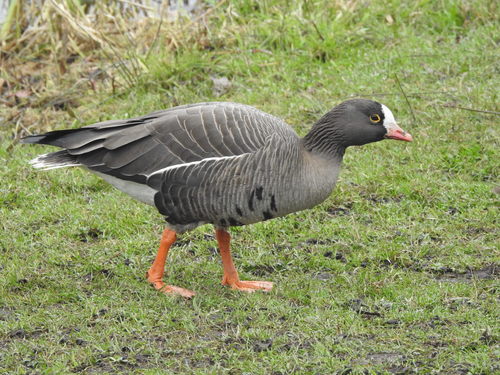
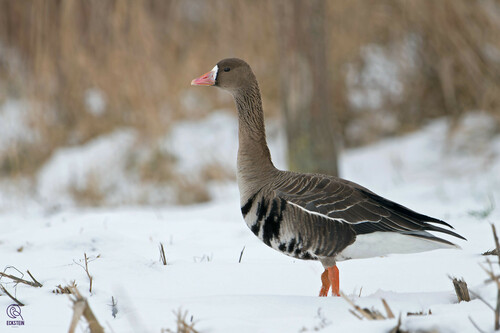
Greater white-fronted geese (Anser albifrons) measure 64–81 cm (25–32 in) in length, have a 130–165 cm (51–65 in) wingspan, and weigh 1.93–3.31 kg (4 lb 4 oz – 7 lb 5 oz). They have bright orange legs and mouse-coloured upper wing coverts, and are smaller than greylag geese. Compared to the lesser white-fronted goose, the greater white-fronted goose is larger, lacks the lesser's yellow eye ring, and its white facial blaze does not extend as far upward as it does on the lesser. Males are typically larger than females, but both sexes share a similar appearance: they are greyish brown birds with light grey breasts dappled with dark brown to black blotches and bars, and both have a pinkish bill. Greater white-fronted geese produce a range of sounds; their most recognizable call is a high-pitched cackle that can be imitated with the sounds "he-he", with a distinct break between the first and second cackle note. For distribution: the North American midcontinent population of subspecies A. a. gambeli had a fall population of around 710,000 birds in 2010, and breeds from the Alaska North Slope across the western and central Canadian Arctic. The Pacific white-fronted goose of the American Pacific coast, which numbered approximately 650,000 birds in 2010, and the tule goose, which is estimated to number 10,000 birds, both nest in western Alaska. Midcontinent geese gather in early fall on the prairies of western Saskatchewan and eastern Alberta, where they spend several weeks feeding before moving to wintering areas near the Gulf of Mexico and into northern Mexico. Pacific birds migrate south along the Pacific coast, staging primarily in the Klamath Basin of southern Oregon and northern California before eventually wintering in California's Central Valley. The tule goose has been somewhat rare since the latter half of the 19th century, and is thought to have been impacted by the destruction of its wintering habitat caused by human settlement. In the British Isles, two subspecies overwinter: Greenland birds overwinter in Scotland and Ireland, while Russian birds overwinter in England and Wales. The geese gather on farmland at favoured traditional sites, with a famous large flock gathering at WWT Slimbridge, Gloucestershire, England. Greenland birds also overwinter in Ireland, and from late September through the winter, Ireland hosts almost 50% of the entire Greenland population of white-fronted geese. Subspecies A. a. albifrons and A. a. flavirostis are among the taxa covered by the Agreement on the Conservation of African-Eurasian Migratory Waterbirds (AEWA). Weather conditions are a key factor that determines the annual breeding success of white-fronted geese. In the Arctic, the available window of time for nesting, incubating eggs, and raising a brood until it can fly is only open briefly, for approximately three months. White-fronted geese arrive in late May or early June, and begin departing for fall staging areas in early September. This means that delayed snowmelt or a late spring storm can significantly reduce the birds' reproductive success.