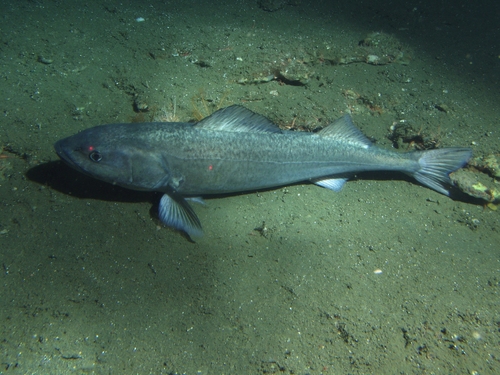
About Anoplopoma fimbria (Pallas, 1814)
Common Name and Distribution
Anoplopoma fimbria, commonly called sablefish, is a deep-sea fish species found commonly in the North Pacific Ocean.
Diet
Adult sablefish are opportunistic piscivores that prey on Alaskan pollock, eulachon, capelin, herring, sandlance, and Pacific cod, as well as squid, euphausiids, and jellyfish.
Lifespan
Sablefish are long-lived; the maximum recorded age for this species is 94 years, though most individuals caught commercially in many areas are less than 20 years old.
Growth Regional Variation
Growth of sablefish varies across different regions, with the largest maximum sizes recorded in Alaska.
Maximum Recorded Size
In Alaska, sablefish have been documented reaching total lengths up to 114 cm (3 ft 9 in) and weights up to 25 kg (55 lb).
Average Adult Size
Most adult sablefish are smaller, with average lengths typically below 70 cm (2 ft 4 in) and average weights typically below 4 kg (8.8 lb).
Maximum Recorded Movement
Results from tagging studies show that sablefish can move as far as 2,000 km (1,200 mi) before being recaptured.
Average Movement Rates
One study estimated the average distance between a sablefish’s release and recapture is 602 km (374 mi), with an average annual movement of 191 km (119 mi).
Culinary Profile
For culinary use, sablefish has soft-textured, mildly flavored white flesh, and is considered a delicacy in many countries.
Cooked Texture Comparison
When cooked, its flaky texture is similar to that of Patagonian toothfish, also known as Chilean sea bass.
Fat Content and Preparation Methods
The meat has a high fat content, and can be prepared in many ways, including grilling, smoking, frying, or serving raw as sushi.
Omega-3 Content
Sablefish flesh is high in the long-chain omega-3 fatty acids EPA and DHA, containing roughly the same amount of these fatty acids as wild salmon.
Smoked Sablefish in New York Cuisine
Smoked sablefish, often referred to simply as "sable", has long been a staple product at New York appetizing stores.
American Jewish Culinary Use
It is one of many smoked fish products typically eaten with bagels for breakfast in American Jewish cuisine.
Japanese Saikyo Yaki Preparation
In Japanese cuisine, sablefish (called gindara, or black cod) is often prepared in the saikyo yaki style: it is marinated for several days in sweet white miso or sake lees (kasuzuke), then broiled.
Nobu Signature Dish Origins
Japanese-Peruvian-American chef Nobu Matsuhisa introduced his version of gindara saikyo yaki at his restaurant in Los Angeles, then brought the dish to his New York restaurant Nobu in 1994.
Nobu Dish Naming
There, it became his signature dish under the name "Black Cod with Miso".
Seattle Culinary Popularity
Kasuzuke sablefish is popular in Seattle due to the area’s large Japanese community.


