About Anoplophora glabripennis (Motschulsky, 1854)
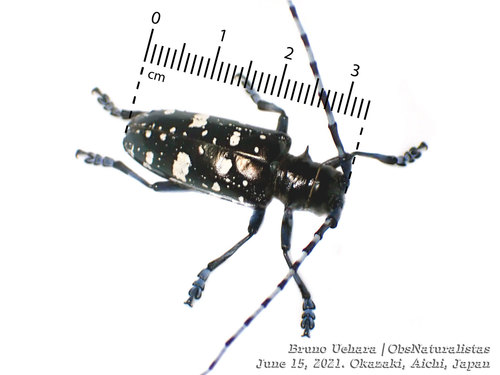
Taxonomy and common names: In Asia, Anoplophora glabripennis has several common names: starry sky beetle, basicosta white-spotted longicorn beetle, and smooth shoulder-longicorn. In North America, it is widely known as the Asian long-horned beetle, abbreviated ALB. Description: Adult A. glabripennis are very large beetles, with body lengths ranging from 1.7 to 3.9 cm (0.67 to 1.54 inches). Their antennae can reach up to 4 cm (1.6 inches) long, and are typically 1.5 to 2 times longer than the beetle’s body. Adults have shiny black bodies, with approximately 20 white spots on each wing cover, and long conspicuously black-and-white banded antennae. Like other large, heavy Cerambycidae, these beetles can fly but generally only travel short distances. The upper segments of adult legs are whitish-blue. A. glabripennis can be told apart from related species by its unique wing cover markings and antenna banding pattern. Range, habitat, and host trees: This beetle is native to eastern Asia, primarily eastern China and Korea. It was recorded in Japan as early as the mid-1800s, but it is uncertain whether it is native to Japan. It is an invasive species outside its native range. In its native range, A. glabripennis primarily infests maple, poplar, willow, and elm trees. In the United States, the species has successfully completed full development on the previously listed genera, plus Aesculus, Albizia, birch, katsura, ash, planes, and Sorbus. In Canada, full development has only been confirmed on maple, birch, poplar, and willow, though egg-laying (oviposition) has been observed on other tree genera. In North America, maple is the most frequently infested tree genus, followed by elm and willow. In Europe, full development has been recorded on maple, Aesculus, alder, birch, hornbeam, beech, ash, planes, poplar, Prunus, willow, and Sorbus. The five most commonly infested host genera in Europe, in order from most to least frequent, are maple, birch, willow, Aesculus, and poplar. Not all poplar species are equally susceptible to infestation. Other economically important tree and plant species attacked by A. glabripennis include domestic apple (Malus domestica), white mulberry (Morus alba), stone fruits (Prunus spp.), pear (Pyrus spp.), roses (Rosa spp.), and black locust (Robinia pseudoacacia). Established populations of A. glabripennis were first discovered in North America in August 1996 in Brooklyn, New York. Since that time, they have been found in other areas of New York, plus New Jersey, Massachusetts, Illinois, Ohio, and Ontario, Canada, but they have been eradicated from some regions within these states and provinces. The first confirmed detection in South Carolina was on June 4, 2020, at a private residence in Hollywood, Charleston County. In response, Clemson University's State Crop Pest Commission (the state regulatory body for crop pests) and the federal Animal and Plant Health Inspection Service (APHIS) both declared a quarantine. In Europe, established populations have been found in Austria (first detected in Braunau am Inn in 2001), Belgium, France, Germany, Italy, Switzerland, and the United Kingdom. The beetle has also been intercepted during inspections of international trade goods, particularly wood packaging. After 4 years (2 full life cycles) with no detections in Gallspach, Austria’s last remaining infested site, Austria was declared free of A. glabripennis in January 2021.