About Anoplolepis custodiens (Smith, 1858)
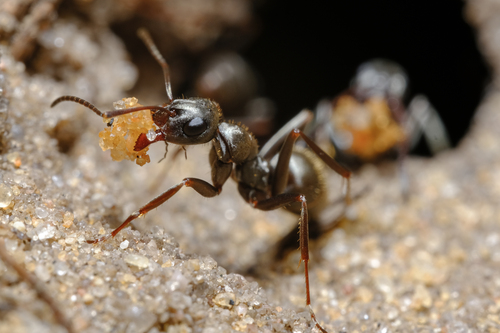
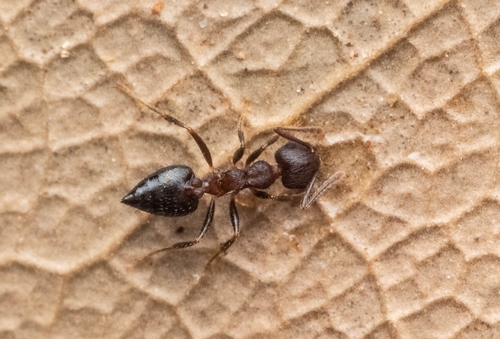
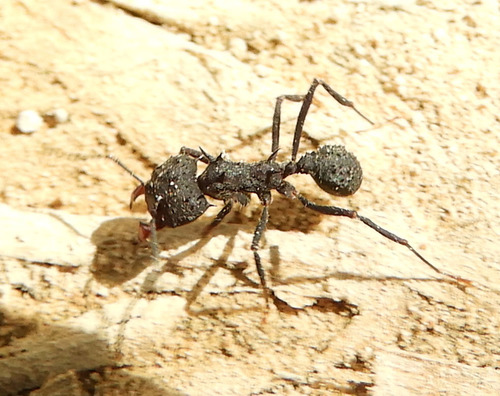
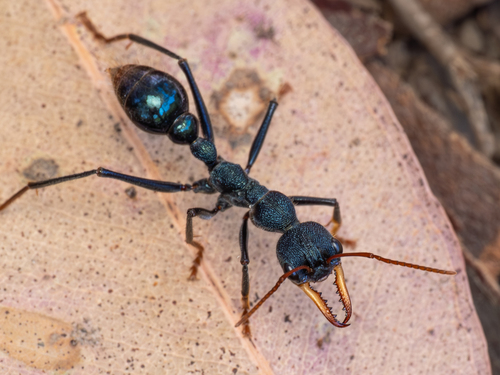
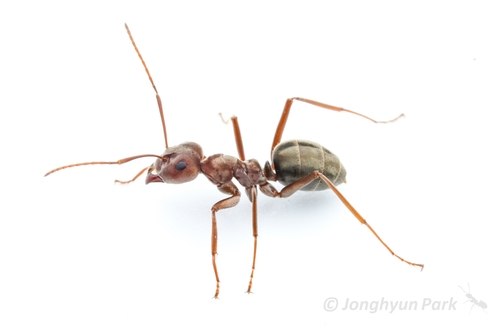
Common pugnacious ant workers (Anoplolepis custodiens) are highly variable in size, reaching up to 10 mm (0.4 in) long. This species is polymorphic, and individuals can be yellowish-brown, reddish-brown, or darker chocolate-brown. The abdomen is often darker than the rest of the body. Dark A. custodiens can be distinguished from the closely related black pugnacious ant (Anoplolepis steingroeveri) by the chequer-board dark pattern on its gaster, which forms when pubescent hairs reflect light differently due to lying in opposite directions on the two gaster sides.
This ant is native to tropical sub-Saharan Africa, with a confirmed range covering Angola, Botswana, Democratic Republic of Congo, Eswatini, Ethiopia, Lesotho, Mozambique, Namibia, South Africa, Tanzania, Zambia, Zanzibar, and Zimbabwe. It is a terrestrial species that lives in dry, open habitats such as South Africa’s Karoo, and also occurs in cultivated areas and vineyards.
Anoplolepis custodiens is a very aggressive ant that typically dominates local ant communities where it occurs. Despite this aggression toward other species, it tolerates members of its own species from other colonies, a trait that may facilitate local invasive expansion. It is a generalist feeder that consumes dead and living animal material, nectar, and honeydew. Both larger and smaller workers forage on the ground, while almost exclusively smaller workers forage in bushes, which suggests workers may take on size-related foraging roles. A study of pangolins in South Africa’s Sabi Sand Game Reserve found that pangolins feed only on ants and termites, and A. custodiens made up 77% of their diet, mostly dug from shallow underground locations. A. custodiens also makes up a large proportion of aardvark diet, and is the most prominent prey species for aardvarks in the region, though this mostly reflects that A. custodiens is the most abundant local ant species.