About Anoplognathus porosus (Dalman, 1817)
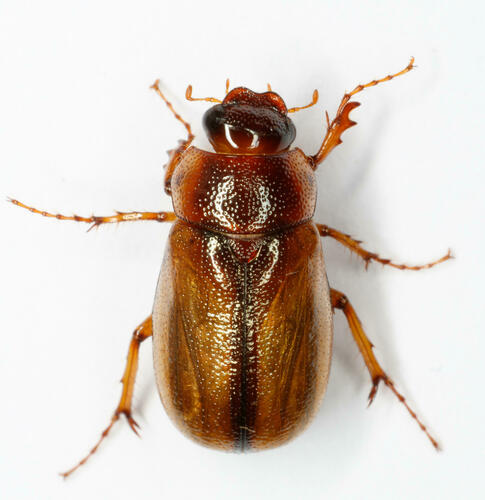
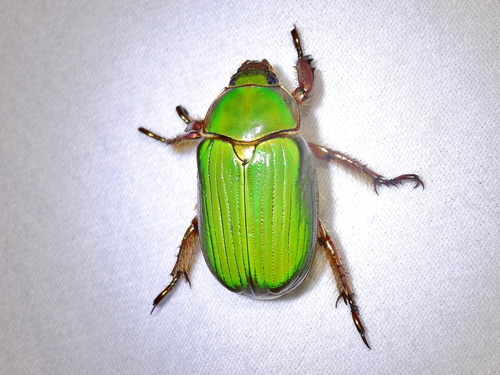
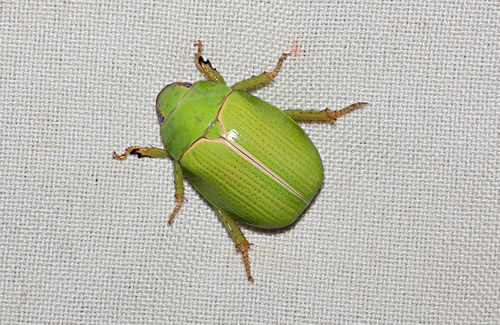
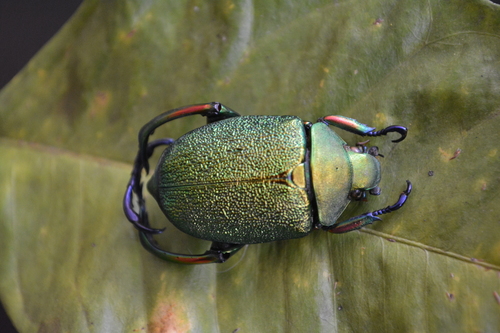
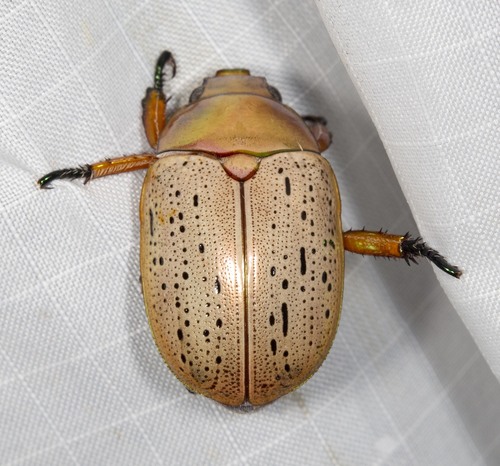
Anoplognathus porosus is the most variable in appearance among all Christmas beetles, so it is often misidentified as the related species A. boisduvali, A. pallidicollis, and A. rugosus. It is generally pale reddish brown, with the head and elytra tinted with a greenish-pink lustre, or a solid darker brown. This tinting is more visible on the pronotum and scutellum. The abdomen is a rich ruddy-brown with a green shine. The legs are also light brown with a green lustre, though the tarsi (the final segment of each leg) are black while still carrying a greenish lustre. The pygidium, the final segment of the body, is pink or green, and has short white hairs along its sides and midline. The elytra have black indents (punctures) arranged in irregular lines. The underside of the beetle has white hairs: longer hairs cover most of the underside of the thorax, excluding the midline, while sparser, smaller hairs are only found along the sides of the abdomen. The sexes of A. porosus can be distinguished by examining the clypeus. Males measure 17 to 23 millimetres (0.67 to 0.91 in) in length, while females are slightly larger, ranging from 20 to 25 millimetres (0.79 to 0.98 in) long. Anoplognathus porosus is distributed in Australia. Its range covers eastern Queensland from Cooktown, through Brisbane and Toowoomba, to Stanthorpe; New South Wales, including the Blue Mountains, extending inland as far as Cassilis and Cooma; the Australian Capital Territory; and Victoria, from Ballarat, through Melbourne, to Wodonga and Bruthen. It is common in the Sydney area.