About Anolis grahami Gray, 1845
Species Overview
Anolis grahami Gray, 1845 is a species of anole lizard.
Coloration
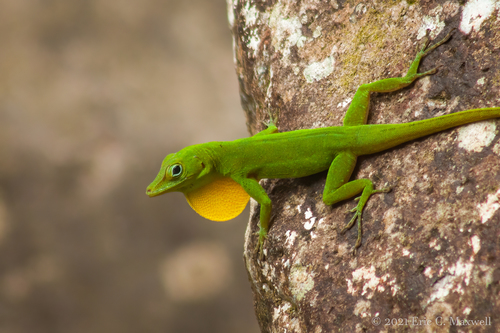
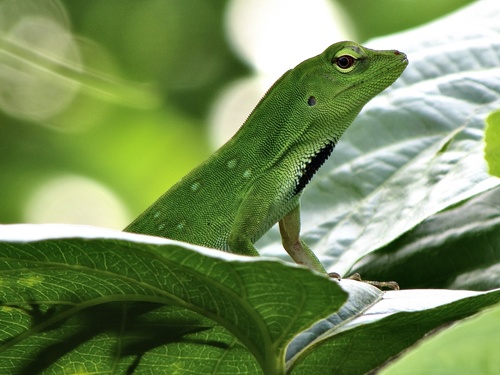
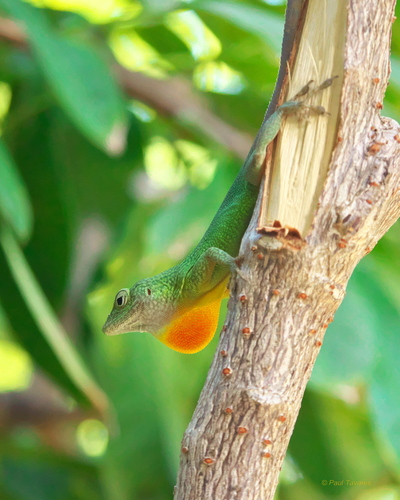
Its upper body is typically a rich emerald or aquamarine, while its trunk and legs are bright deep blue. It has a bright orange dewlap. The first half of the tail is deep blue, and the lower half is brilliant violet.
Underside & Color Variation
Its underside is usually light blue-gray. Occasionally, especially in females and younger individuals, these colors may be somewhat muted, though they are still quite gaudy. Fully grown males can be exceptionally colorful; pure turquoise blue individuals are occasionally observed.
Size
Mature males can reach a total length of 16 centimetres (6.3 in) and a snout–vent length (SVL) of 8 cm (3.1 in), and females are smaller than males.
Defensive/Competitive Behavior
When competing for territory or threatened, males may raise a small dorsal crest on top of their heads.
Taxonomic Classification
Anolis grahami belongs to the family Dactyloidae, a subgroup of Iguania; members of Dactyloidae are commonly called anoles, and this family ranges from the southeastern United States down to Paraguay.
Dactyloid Shared Traits
Most dactyloids have green or brown bodies, and many, including Anolis grahami, can change color. Other shared dactyloid traits visible in Anolis grahami include the ability to autotomize (break off) their tail when trapped, and the presence of a brightly colored dewlap (a skin flap under the neck) used for display.
Anolis Genus Adaptations
Different species in the genus Anolis tend to have very distinct characteristics, due to the wide range of geographic locations and environmental conditions they inhabit. Isolated in different conditions, species have developed different adaptations suited to their specific habitats to improve survival chances.
Limb Length Adaptations
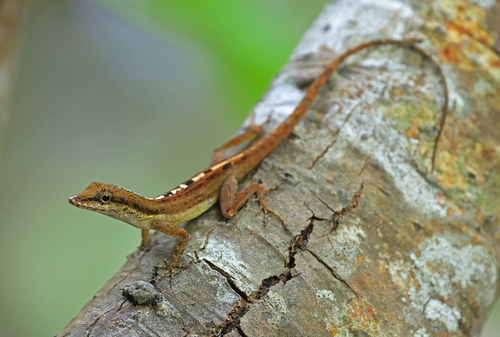
For example, Anolis grahami has relatively longer limbs than terrestrial anole species, as this trait is needed for climbing and walking on tree branches. Among arboreal anole species, limb length varies based on the diameter of the branches the species uses: longer limbs are needed for wider branches, and shorter limbs for narrower branches.
Arboreal Habitat
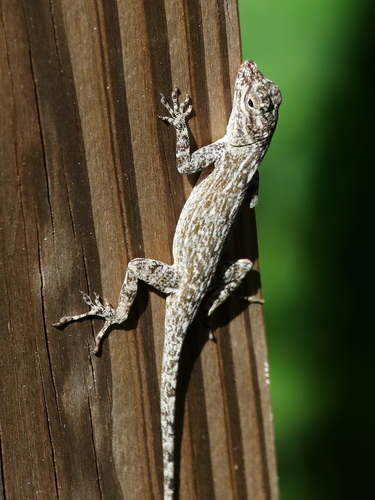
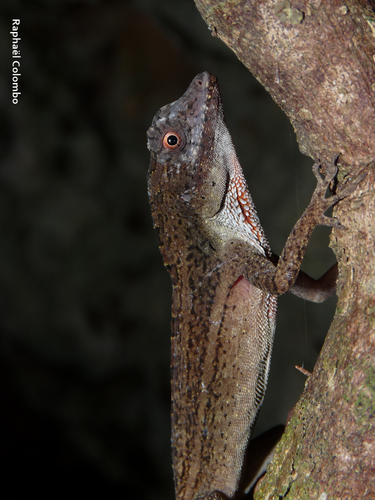
Anolis grahami is highly arboreal. Across its range, it can be found in the uppermost branches of trees, and is also commonly seen on the trunks of tall trees, in shrubbery, on fence posts, on the walls of houses, and other man-made structures.
Population Abundance
Because of its arboreal habits, it can be hard to observe in its natural habitat, but it is actually usually quite common across its range.
Interspecific Competition
On Jamaica, this species fills a similar ecological niche to Anolis lineatopus, and the two species are often in direct competition. In areas where both species occur, Anolis lineatopus is most often found on tree trunks and lower branches (its preferred habitat), while Anolis grahami is most often found in treetops.
Niche Partitioning Parallel
This niche partitioning mirrors the relationship between Anolis sagrei and Anolis carolinensis in North America.
Reproductive Research Status
The reproductive habits of Anolis grahami are not well studied.
Breeding Season
Its breeding season is thought to run from April to September.
Egg Laying
The lizards lay their eggs in secluded spots, such as crevices in decomposing logs or holes in tree trunks. Typically, at least two small white eggs are laid.