About Anolis equestris Merrem, 1820
Adult Total Length
Adult knight anoles (Anolis equestris) have a total length of 13–20 inches (33–51 cm) including the tail, which is longer than the head-and-body section.
Weight Range
Their weight ranges from 0.56–4.83 oz (16–137 g).
Sexual Size Dimorphism
Males grow larger than females: adult males have a snout–vent length of 3.9–7.5 in (10–19 cm), while adult females have a snout–vent length of 3.5–6.3 in (9–16 cm).
Body Coloration
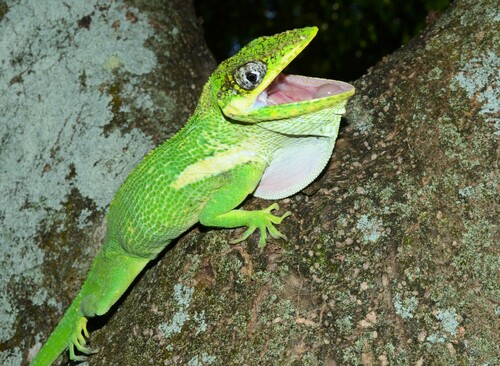
Their base coloration is mostly bright green, with one yellow stripe along the side of the head and a second yellow stripe on the shoulder, and they are capable of limited color change.
Dewlap and Juvenile Markings
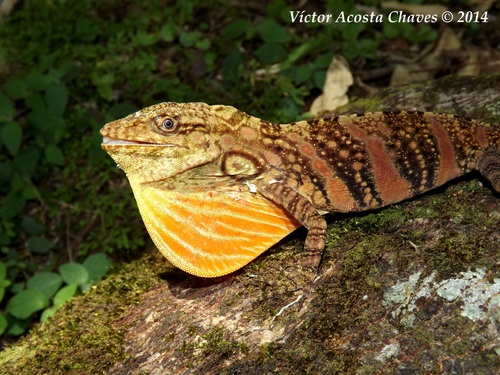
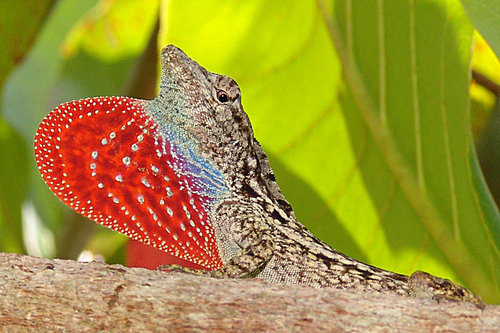
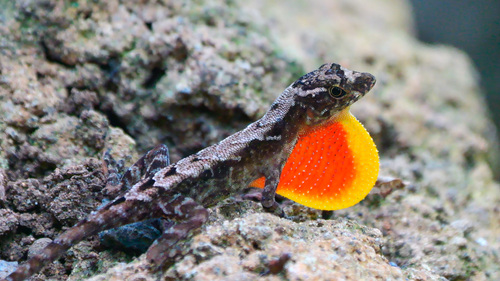
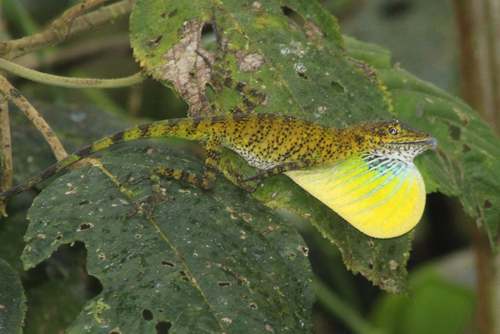
They have a pinkish-white dewlap, and juvenile knight anoles have light bands across their bodies.
Native and Introduced Range
Knight anoles are native to Cuba, but have been widely introduced into South Florida, where they successfully reproduce and spread as an invasive species.
Cold Temperature Response
They cannot tolerate cold temperatures; during winter freezes in Florida, they have been observed falling to the ground from tree canopies, a behavior also seen in green iguanas.
Social and Territorial Behavior
Outside of specific cold weather aggregations, this species is solitary and highly territorial.
Native Cold Weather Aggregation
In the relatively cold winters of highland regions in their native Cuba, a small number of individuals may rest next to one another.
Cuban Habitat and Altitude
In Cuba, they occur from near sea level up to an altitude of 3,300 ft (1,000 m) across a broad variety of tree-containing habitats, including forest, mangrove, savanna, cultivated areas and gardens.
Florida Introduced Habitat
In their introduced Florida range, they can even be found in trees along roads in Miami.
Arboreal Habit
Knight anoles are arboreal, and are mostly found high in trees on the trunk or canopy branches.
Ground Movement Behavior
They will descend to the ground to move between trees or for thermoregulation, and are occasionally seen on warm asphalt, rocks, or sidewalks during these trips.