About Anolis cuvieri Merrem, 1820
Size
Anolis cuvieri is a relatively large anole lizard, with a mean snout–vent length reaching up to 132 mm (5.2 in).
Body and Limb Structure
It has a large, robust skull, long hind legs, and a serrated ridge of raised scales along its back.
Toe Adhesion Structure
Like most anoles, this species has large flattened disks under the second and third phalanges of each toe, which allow it to adhere to vertical surfaces.
Basal Body Coloration
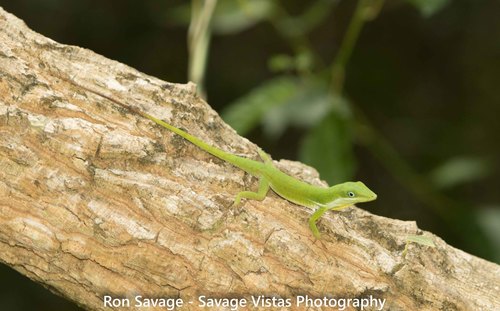
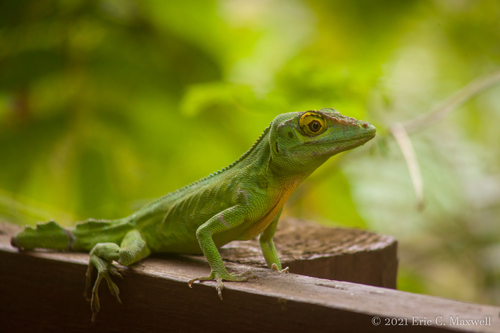
This species is predominantly green; some individuals have faint light green stripes on the sides and dorsal surface.
Male Blue Head Coloration
In some specimens, especially large adult males, the head has heavy sky blue blotches that spread onto the nape.
Extent of Male Blue Coloration
This blue coloration may extend to the neck, or even all the way along the dorsal surface to the length of the spine.
Female Blue Coloration
When blue coloration is present in females, it only appears as a sky blue tint on the head and does not extend to the neck.
Orbital Area Coloration
In both males and females, the area around the eyes is either bright yellow or vibrant yellow-green.
Dewlap Presence
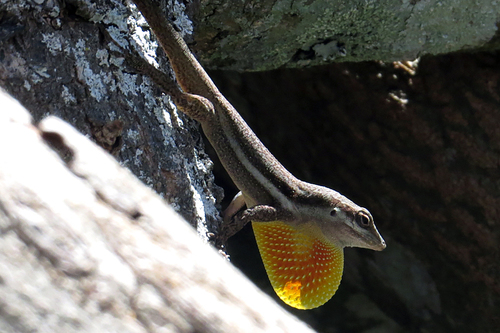
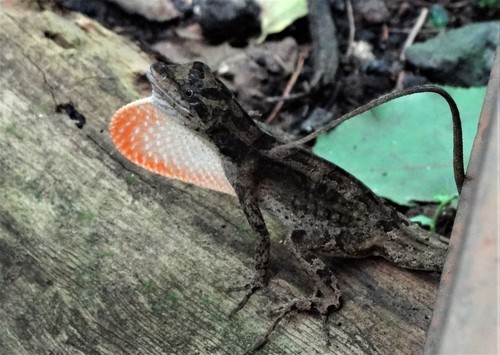
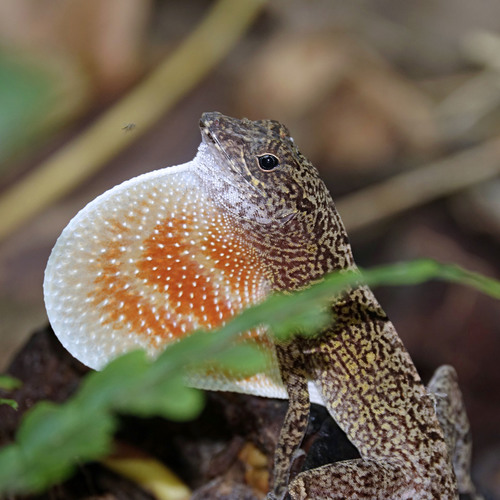
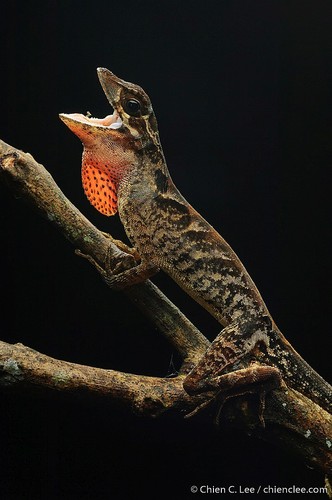
Both male and female Puerto Rican giant anoles have a large dewlap.
Dewlap Sexual Dimorphism
However, the male dewlap is noticeably larger and bright yellow, while the female dewlap is light green with a blue-green upper portion and faint black stripes running horizontally across the upper two-thirds.
Juvenile Coloration
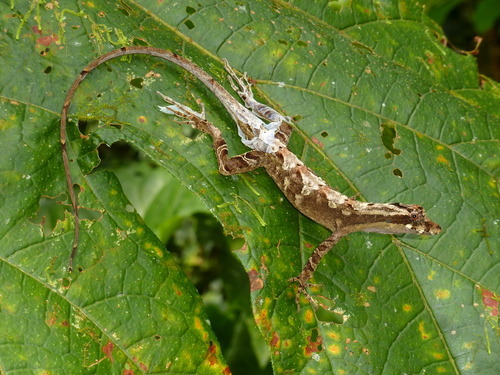
The coloration of Anolis cuvieri changes with age: juveniles of both sexes are gray-brown or brown, with brown vertical stripes along the entire dorsal surface of the body and limbs.
Ontogenetic Color Shift
As they mature, juveniles gradually develop the green coloration of adults.
Rare Brown Adult Morph
There is also a rare brown adult morph of Anolis cuvieri that is solid brown across the body, with black spots on the sides and neck, and a yellow-blotched orbital area.
Tail Crest Structure
Both sexes have a large erectile crest on the tail, though it is usually higher in males.
Ecological Guild Classification
Anolis cuvieri is a crown giant anole, a group of large species that live in the uppermost canopy of tall trees and rarely descend to ground level.
Habitat Requirement
It is only found in intact forest regions that contain large numbers of large trees.
Vertical Activity Range and Host Trees
It is typically active several meters above the ground, and occurs mainly in palms, Ficus trees, and other large trees.
Locomotion
This species moves by jumping from branch to branch within the canopy, a lifestyle for which its long hind limbs are evolved.
Moisture Preference
It is a mesic species that prefers wet forest areas over more xeric conditions, where it is rarely found.