About Annona macroprophyllata Donn.Sm.
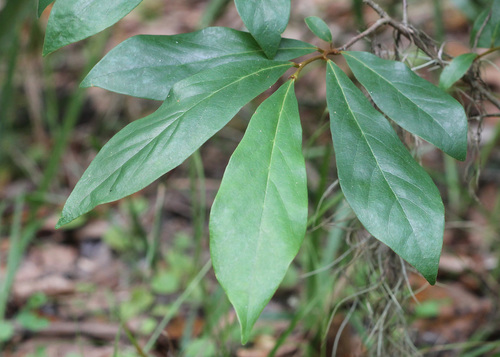
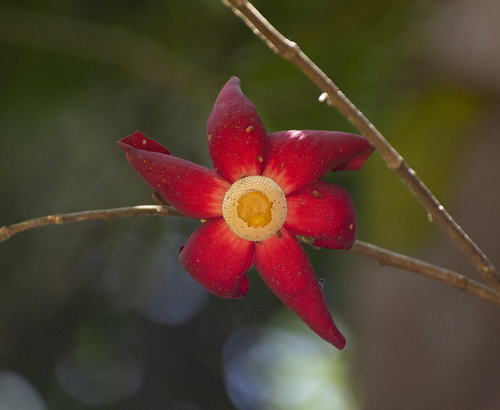
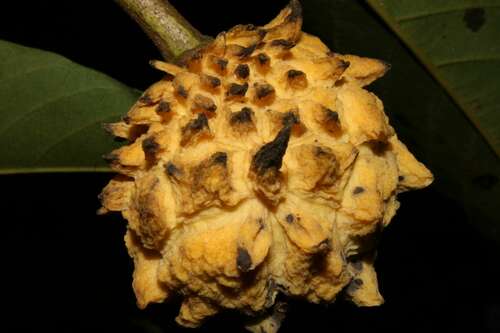
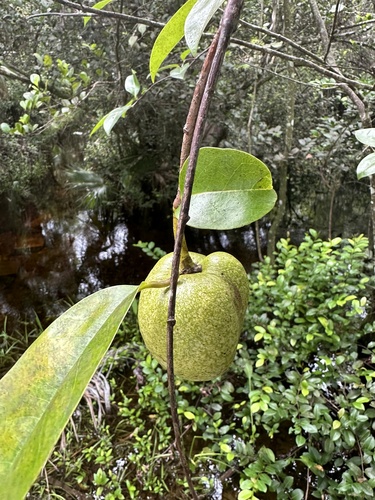
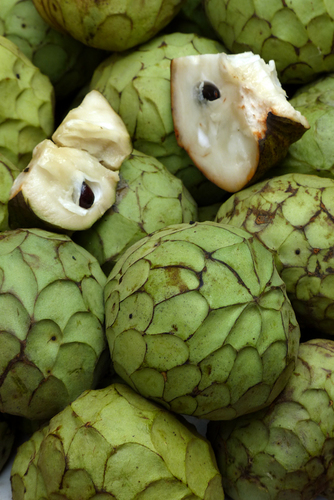
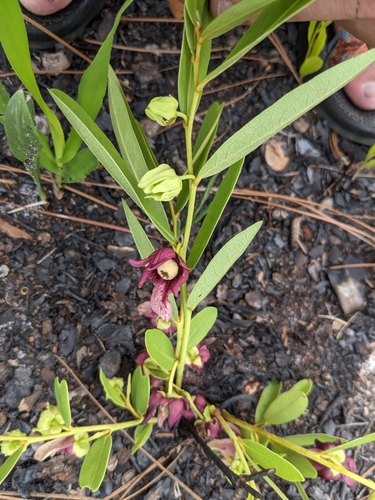
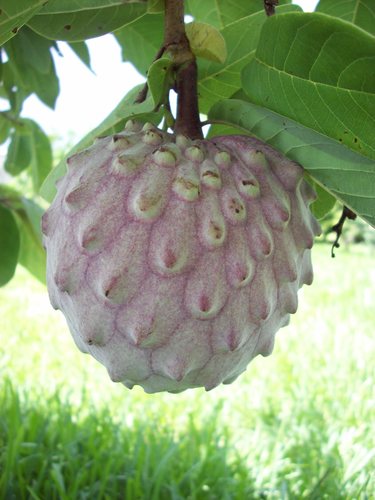
Annona macroprophyllata Donn.Sm. is a bush that grows 3 to 4 meters tall. It has membranous, elliptical leaves that measure 4-6 by 2–3.5 centimeters, with rounded or slightly indented tips. The leaves are hairless on both surfaces, and their petioles are 2–3 millimeters long. Its flowers are solitary and grow on pedicels 1–2.7 centimeters long. It has oval sepals 3–4 millimeters long, covered in rust-colored shaggy hairs. Its outer petals measure 20 by 5–7 millimeters, are covered in fine hairs, and when mature are thick and fleshy: the outer surface is green at the base and yellow at the tip, while the inner surface has pink and red highlights. Its inner petals are rudimentary, and its ovaries are hairless. It can be distinguished by its aromatic, pale brownish grey, furrowed bark and glossy, thin, elliptic to obovate or oblanceolate leaves that measure 5.1 to 15.2 centimeters long. One or two leaf-like, nearly circular, hairless bracts about 2.5 to 3.5 centimeters in length clasp the base of the flowering branchlets. New growth has a reddish or coppery tinge. Some sources note the solitary flowers have three minutely hairy, long and narrow maroon petals, with small rusty hairy sepals and stamen-like pollen-bearing inner petals. It has been observed growing at an elevation of 1,110 meters. For cultivation, harvest of this ilama tree occurs in late June in Mexico, and only lasts around two weeks. In Guatemala, the harvest season runs from late July to September, while in cultivated areas in Florida harvest extends from July to December. Traditional practice holds that the fruits should not be picked until they crack, but they can be harvested slightly early and held for up to three days to soften. If picked too early, ilama fruits will never ripen. The yield of ilama is typically low: during a normal fruiting period, some trees produce no fruits, others only produce three to 10 fruits, while exceptional trees can bear as many as 85 to 100 fruits per season. Bioactive molecules extracted from the leaves of this species have been reported to have alpha-glucosidase inhibitor activity.