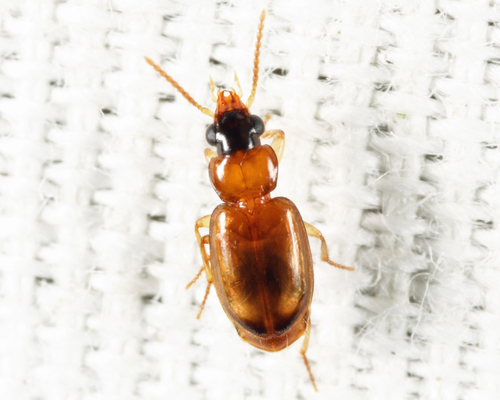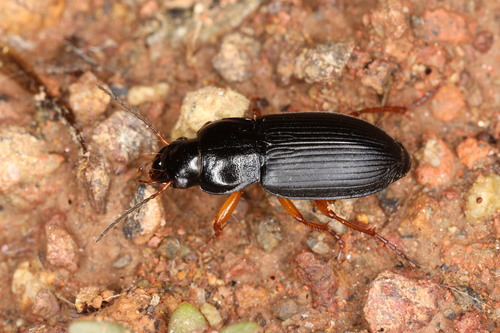
About Anisodactylus binotatus (Fabricius, 1787)
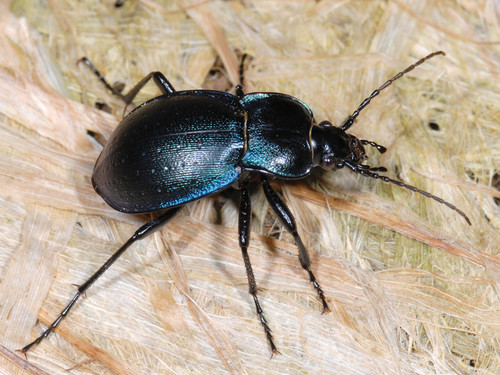
Anisodactylus binotatus (Fabricius, 1787) measures 10–12.7 mm (0.39–0.50 in) in length, and has a non-metallic polished shiny black coloration that covers its head, pronotum (the hard first segment that protects the thorax), and femora (the leg segment connecting the tibia and coxa). As a member of the order Coleoptera, this beetle has hardened, leather-like black forewings called elytra. The elytra have a uniform impressed pattern of small, evenly spaced crinkle-like waves, and light hair-like setae along their sides, and at their base or apex. The tibia (the leg segment connected to the femur) and tarsi (the gripping foot segments) are light brown or red-black. A key defining feature of this species is that the basal segment of its posterior tarsus is twice as long as the second tarsal segment. Members of the Anisodactylus genus can be recognized by the length of the apical spur on their hind tibia. The first segment of the antennae is red-brown, while all remaining segments are black, and the antennae reach the base of the pronotum. A distinctive feature of A. binotatus is a red spot on the frons, the exoskeletal plate that makes up the front of the head between the eyes and above the mouth; some individuals have two separate horizontally elongated red spots in this location. This species also has strongly developed, slightly rounded shoulders that act as a defining trait. A. binotatus is native to Europe, but can be found across the world. In North America, it occurs in coastal states, and it is found throughout Europe and the Portuguese Islands. In the United Kingdom, it has an extensive distribution across England, Ireland, and Wales, and is fairly common in lowland Scotland. The Anisodactylus genus currently includes around twenty-one total species: fifteen are found in the Northern Hemisphere and six in the Southern Hemisphere. Thirteen of these species are native to North America. One species occurs only in Northern Africa, another occurs in both Africa and South West Eurasia, and six are found in Eurasia. A. binotatus is an exotic ground beetle that first established in Christchurch, New Zealand in 1938, and spread across mid Canterbury. Today, it can be found throughout both the North and South islands of New Zealand: in the North Island, it occurs in the Wellington region, and in the South Island it is found in South and Mid Canterbury, Otago Lakes, Central Otago, and Dunedin. A. binotatus lives under substrates including logs, stones, and plant debris, and can also be found in fields and soil burrows, like many other ground beetles. It is a lowland-dwelling species that is often found near water sources such as peat bogs and lake banks, which matches its preference for moderately moist soil and clay loam soils. A. binotatus is an exceptionally successful colonist, in part because it can survive in human-modified (anthropogenic) habitats and niches, including reservoirs, greenhouses, dumps, and cultivated fields with grass or herbaceous cover. Little is known about the natural history and phenology of A. binotatus, but a European study of carabid life cycles included Anisodactylus signatus, a closely related congener. Based on this similarity, it is suggested that A. binotatus has an annual life cycle, producing one new generation each year. Larvae develop over several months before emerging as adults. In New Zealand, A. binotatus larvae reach the imago stage (the final development stage for winged insects) and form pupae during April. The Anisodactylus genus is thought to have a summer reproductive rhythm: in New Zealand, this species is most reproductively active between September and April, and is relatively inactive during colder months, possibly hibernating, similar to other ground beetles. Eleven species in the Carabidae (ground beetle) family have been recorded showing female parental care for eggs and larvae, so it is possible that A. binotatus also exhibits this parental behavior toward its offspring. Like other carabids, A. binotatus stays underground during its larval life stage. After emerging from metamorphosis as adults, beetles live on the surface. Adults are typically nocturnal, but may sometimes be active during warm days. In the UK, adult A. binotatus can use the wings they develop during the pupal stage for flight. This ability is thought to have shaped the species' global distribution, as it lets the beetle disperse across larger distances more easily than many flightless carabids.