About Angraecum sesquipedale Thouars
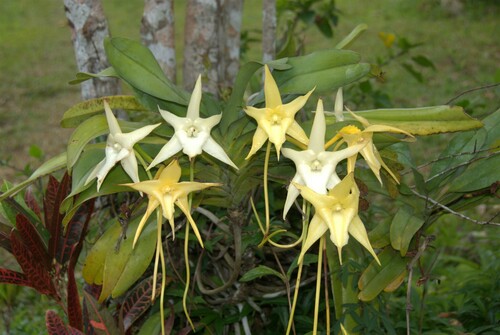
Angraecum sesquipedale Thouars is a monopodial orchid that can reach 1 meter (3.3 feet) in height, with a growth habit similar to species in the genus Aerides. Its leaves are dark green with a slight grayish tone, leathery, and have a bilobed tip. They typically measure 20–40 centimeters (7.9–15.7 inches) long and 6–8 centimeters (2.4–3.1 inches) wide. Its dark gray, thick roots emerge from the orchid’s stem; there are usually few roots, which attach very strongly to tree bark. Each succulent root can grow along a tree trunk for several meters. This species is known for its famously long nectar spurs that extend from the back of its flowers. On average these spurs grow 33 centimeters long, and can reach up to 43 centimeters or as short as 27 centimeters. The spur measures 27–43 centimeters (10.6–16.9 inches) from its tip to the tip of the flower’s lip. The specific epithet sesquipedale is Latin for "one-and-a-half-feet long", referring to the distance between the end of the spur and the top of the dorsal sepal. Star-shaped, waxy flowers grow on 30-centimeter (11.8-inch) inflorescences that emerge from the stem. In the wild, flowering occurs from June to September, with most flowers wilting by August; when cultivated in Europe, the plant flowers between December and January. This flowering timing gives the orchid common names like "Christmas orchid", while its flower shape gives it the common name "comet orchid". Newly opened flowers are green, and gradually turn white with light green tones; the amount of green in each flower varies between individual plants. It is reported that this age-dependent color change is more noticeable in wild A. sesquipedale than in greenhouse-grown specimens. Sepals remain green longer than petals. As flowers age further, they shift from white to yellowish, then to orange, and finally to brown as they begin wilting. As wilting progresses, the dorsal sepal bends downward, followed by the lateral sepals bending inward, while the lip stays mostly stationary, and eventually the entire flower closes in on itself. A small amount of nectar, usually 40–300 microliters in volume, sits at the end of the long green spur. In general, longer spurs hold higher nectar concentrations, and nectar fills the spur from 7 to 25 centimeters (2.8 to 9.8 inches) up from the base of the spur. The nectar contains the sugars fructose, sucrose, glucose, and raffinose. The flowers produce an extremely strong spicy scent that can easily fill an entire room. This fragrance is only released at night, and is similar to the scent of lilies and some night-flowering Nicotiana species. The fragrance is made up of around 39 different chemical compounds, with the largest concentrations coming from isovaleraldoxime, methyl benzoate, benzyl alcohol, isovaleronitrile, benzyl benzoate, phenylethyl alcohol, isovaleraldehyde, and phenylacetaldoxime. Plants typically produce 1 to 5 flowers at a time. In the wild, this orchid is most often found in lowland Madagascar below 120–150 meters (400–500 feet) elevation, near the island’s east coast, growing on trees at forest edges. It usually attaches to trees with fewer leaves, on the driest sections of branches or trunks, which allows the plant to get plenty of light and air movement. Larger plants are usually found 12–20 feet above ground, while smaller plants tend to grow higher in the canopy. Rarely, A. sesquipedale can also grow as a lithophyte, and occasionally even as a semi-terrestrial plant. Its native habitat receives heavy annual rainfall, up to 380 centimeters (150 inches) per year, with no dry season, so growth occurs continuously year-round. William Ellis first brought Angraecum sesquipedale to the United Kingdom for cultivation outside its native range in 1855, and achieved the first cultivated flowering of the species in 1857. Cultivated plants are often considered more attractive than wild specimens, as wild plants typically have a long stem with just a few small, sparse leaves. Despite its major importance to Darwin’s concept of coevolution, and to the fields of botany and evolutionary biology, A. sesquipedale is rarely grown in private collections. Cultivation recommendations call for growing the plant in warm to intermediate conditions, with as much light as possible without burning the leaves. Growing the plant in intermediate or warm temperatures can alter the timing of its flowering. To encourage heavy flowering, light intensity should be highest between September and November. The number of flower spikes produced during flowering depends on the number of new leaf pairs that formed the previous spring and summer, as each new leaf pair produces one flower spike, and rarely two. Angraecum sesquipedale grows slowly, but can produce flowers even before it reaches full adult size. It is well known for having sensitive roots. Mature plant roots should be disturbed as little as possible, so extra care must be taken during repotting; young plants are less prone to root disturbance issues. Disturbing the roots can cause the plant to grow poorly for two to four years, or even die. When a mature plant is disturbed, it often loses many lower leaves and only produces one or two flowers at a time going forward. To avoid these issues, the orchid is commonly recommended to be potted in a coarse growing medium such as fir bark, crock, or charcoal to minimize the need for root disturbance. It also grows best in a basket or large pot, which lets the orchid grow for many years before its roots need to be disturbed.