About Angophora woodsiana F.M.Bailey
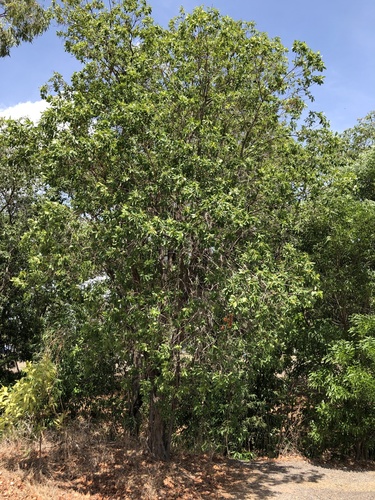
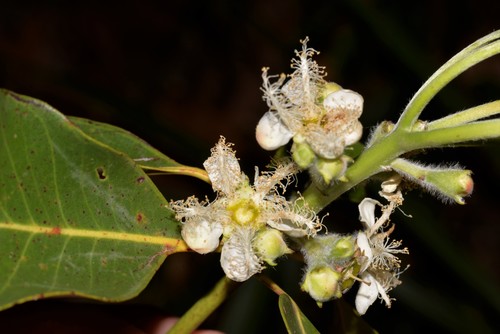
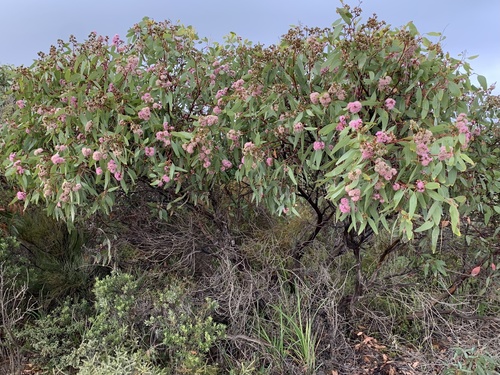
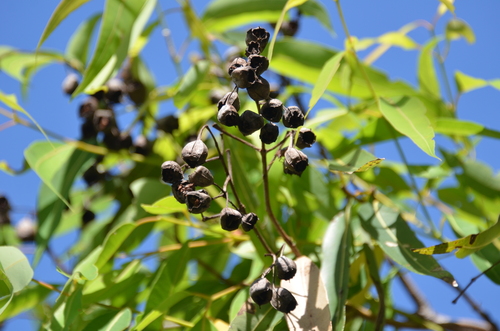
Angophora woodsiana F.M.Bailey is a tree that typically reaches 20 metres (66 feet) in height and forms a lignotuber. Its trunk and branches are covered in rough, fibrous grey or brownish bark. Young plants and coppice regrowth have egg-shaped to lance-shaped leaves arranged in opposite pairs, that measure 55–100 mm (2.2–3.9 in) long and 20–30 mm (0.8–1.2 in) wide. Adult leaves are also arranged in opposite pairs; they are glossy green, paler on the lower surface, lance-shaped or curved, 75–170 mm (3.0–6.7 in) long and 17–45 mm (0.7–1.8 in) wide, tapering to a petiole 10–20 mm (0.4–0.8 in) long. Flowers are arranged at the ends of branchlets on a branched peduncle 9–32 mm (0.4–1.3 in) long. Each branch of the peduncle holds three or seven buds, each on a pedicel 10–18 mm (0.4–0.7 in) long. Mature buds are globe-shaped, 6–7 mm (0.24–0.28 in) long and wide, with a ribbed floral cup. The petals are white or creamy white with a green keel, measuring 3–4 mm (0.12–0.16 in) long and wide. Flowering takes place in December and January. The fruit is a cup-shaped capsule 10–15 mm (0.4–0.6 in) long and wide, with its valves enclosed inside the fruit. This species, commonly known as smudgee, grows in sandy soil on sandstone hills in forested areas. Its range extends from Tin Can Bay in Queensland to Coffs Harbour in New South Wales, with sporadic populations found on the Darling Downs.