About Angophora subvelutina F.Muell.
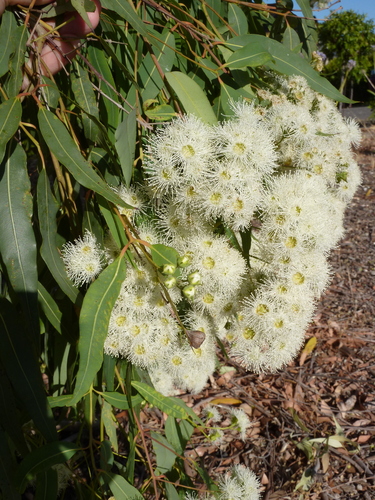
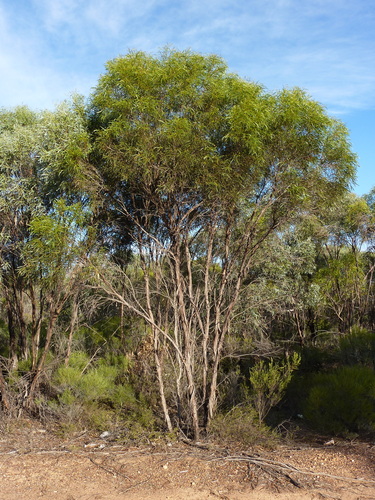
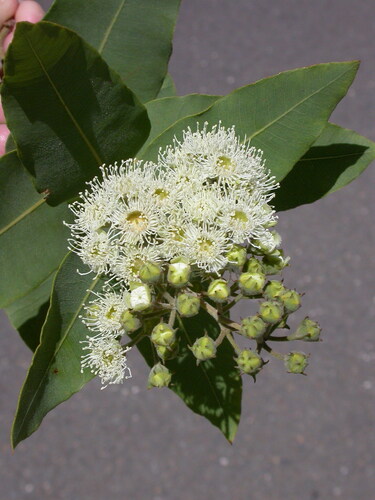
Angophora subvelutina F.Muell., also known as broad-leaved apple, is a tree species that typically reaches a height of 17 to 25 meters (56 to 82 feet) and forms a lignotuber. It has rough, fibrous or flaky greyish bark covering its trunk and branches. Young plants and coppice regrowth have sessile leaves arranged in opposite pairs, with a stem-clasping base; these leaves are egg-shaped to elliptical or lance-shaped, 50 to 110 millimeters (2.0 to 4.3 inches) long and 25 to 50 millimeters (1.0 to 2.0 inches) wide. Adult leaves are also arranged in opposite pairs, have a paler lower surface, and are lance-shaped to egg-shaped or elliptical; they measure 60 to 120 millimeters (2.4 to 4.7 inches) long and 20 to 50 millimeters (0.8 to 2.0 inches) wide, and also have a stem-clasping base. Flower buds are arranged at the ends of branchlets on a branched peduncle 9 to 30 millimeters (0.4 to 1.2 inches) long. Each branch of the peduncle holds three or seven buds, each on a pedicel 4 to 10 millimeters (0.2 to 0.4 inches) long. Mature buds are globe-shaped, 4 to 6 millimeters (0.16 to 0.24 inches) long and wide, with a ribbed floral cup. The petals are white or creamy white with a green keel, about 3 millimeters (0.12 inches) long and 3 to 4 millimeters (0.12 to 0.16 inches) wide. Flowering occurs from November to January. The fruit is a cup-shaped capsule 8 to 11 millimeters (0.3 to 0.4 inches) long and 6 to 11 millimeters (0.2 to 0.4 inches) wide, with ribbed sides and valves enclosed inside the fruit. This species grows in open forest on alluvial soil and gravelly clay. It occurs mainly in near-coastal areas, ranging from near Bundaberg in Queensland south to near Taree in New South Wales, with a separate disjunct population near Araluen, New South Wales. The 1889 publication *The Useful Native Plants of Australia* records that Reverend Dr. Wolls reported these "apple trees" are sometimes cut down to keep cattle alive during dry seasons, because cattle readily eat their leaves.