About Angophora hispida (Sm.) Blaxell
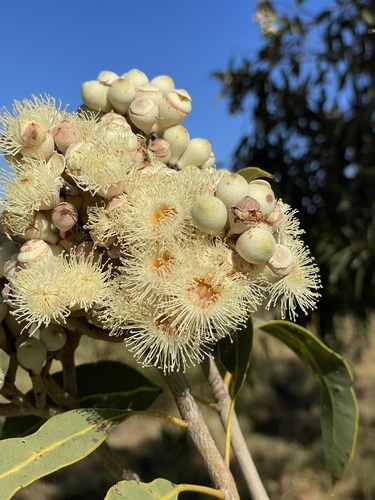
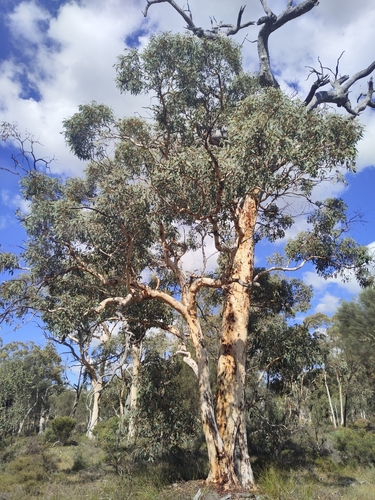
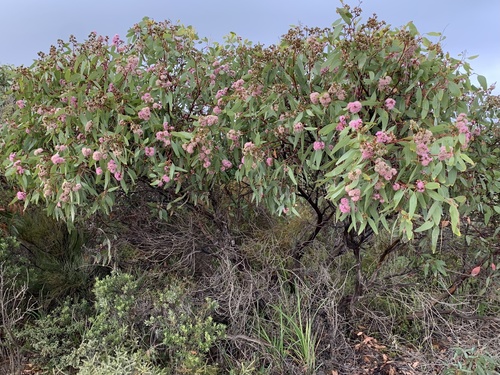
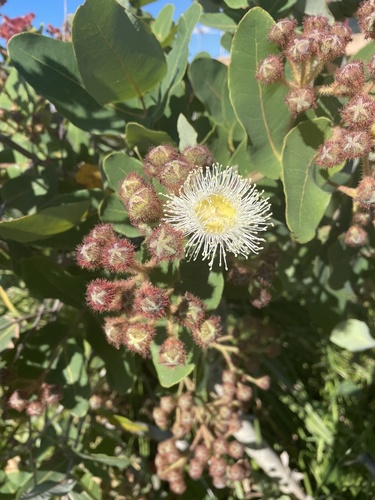
Commonly known as dwarf apple, Angophora hispida grows as a small tree or mallee reaching up to 7 metres (23 feet) in height. It has greyish flaky bark. Like other members of the genus Angophora and unlike other eucalypts, its leaves are arranged oppositely along the stem. The leaves attach to stems via petioles 0 to 4 millimetres long; they have an ovate to elliptic shape, measure 5–10 cm (2.0–3.9 in) in length and 3–4.5 cm (1.2–1.8 in) in width, and have a blunt rounded apex and a cordate (heart-shaped) base. Leaf upper surfaces are pale yellow-green, while undersurfaces are greyish. All new growth is covered in reddish hairs. Flowering occurs between November and January. Its showy creamy-white flower heads grow at stem terminals, form an umbellate shape, and hold 3 to 7 flowers each. Each individual flower sits on a pedicel 0.8–3.2 cm (0.31–1.26 in) long, and these pedicels branch from a central peduncle 1.5–7 cm (0.59–2.76 in) long. Like new leaves and stems, developing flower buds are covered in reddish hair. The buds are globular with longitudinal ribbing, and grow 0.9–1.3 cm (0.35–0.51 in) in diameter. After flowers fall, the plant develops cup-shaped woody seed pods (fruit) that measure 1.5–2.6 cm (0.59–1.02 in) in length and 1.3–2 cm (0.51–0.79 in) in diameter. These pods shed mature seeds in February and March. The seeds are oval, brown, and flat, measuring 0.8–1 cm (0.31–0.39 in) long. Dwarf apple is found only in the Sydney Basin, growing as far south as O’Hares Creek off the Georges River. It grows on low-nutrient dry sandstone soils, at altitudes from sea level to 300 m (980 ft), in areas that receive 800 to 1,600 mm (31 to 63 in) of annual rainfall. Its associated plant communities are heath, scrubland, or open woodland, where it grows alongside scribbly gums (Eucalyptus racemosa and E. haemastoma), red bloodwood (Corymbia gummifera), narrow-leaved apple (Angophora bakeri), heath banksia (Banksia ericifolia), rusty banksia (B. oblongifolia), silver banksia (B. marginata), conesticks (Petrophile pulchella), scrub sheoak (Allocasuarina distyla), wax flower (Eriostemon australasius), and parrot pea (Dillwynia floribunda). After bushfire, dwarf apple regenerates by resprouting from its woody base (called a lignotuber) or from epicormic shoots. It can flower within one year after a fire, and acts as an important food source for nectar-eating insects in the period after bushfire. Its flowers attract birds including the noisy miner and wattlebirds, as well as a wide variety of insects: honeybees, native bees, flies, moths, butterflies, and many beetles. Recorded beetle visitors include the rose chafer (Eupoecila australasiae), green-velvet flower chafer (Glycyphana brunnipes), variable jewel beetle (Temognatha variabilis), cowboy beetle (Chondropyga dorsalis), and scarab beetle Bisallardiana gymnopleura, as well as members of the scarab genus Phyllotocus and the soldier beetle genus Telephorus. Dwarf apple is also a host for the larvae of froghoppers, commonly known as spittlebugs, and has been recorded as a host for the mistletoe species Muellerina eucalyptoides. This small tree is suited to larger gardens in horticulture, valued for its attractive reddish new growth and profuse white flowers. It flowers in summer, and its blooms attract brightly coloured beetles. It grows best when planted in a sunny location with good drainage.