About Angophora floribunda (Sm.) Sweet
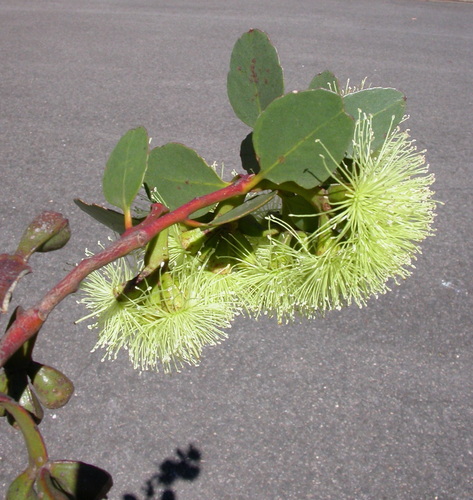
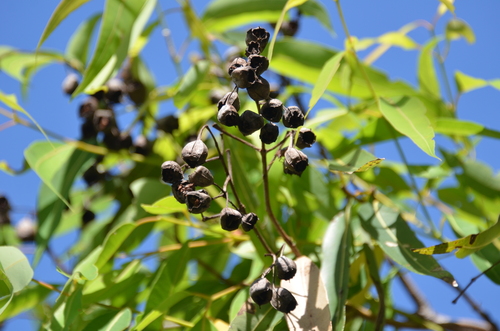
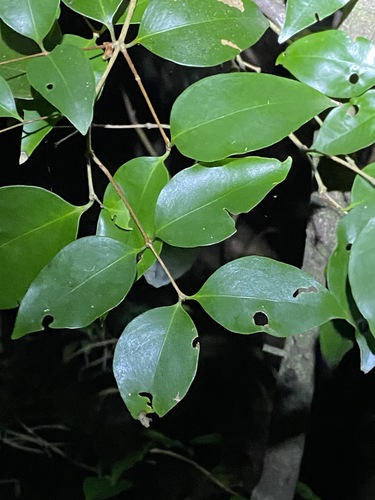
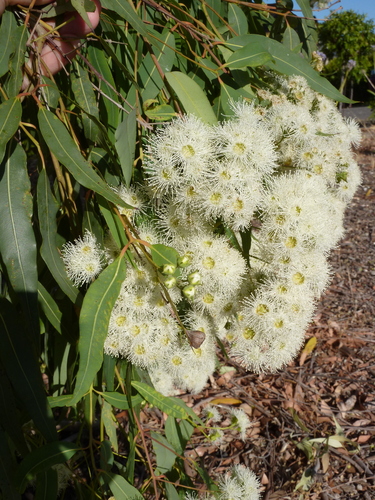
Angophora floribunda is a large, broad spreading tree that reaches a maximum height of 30 metres (100 feet). Its trunk is often gnarled and crooked, covered in fibrous grey bark. Like all species in the genus Angophora, its leaves, which range from dull to glossy green, are arranged oppositely along the stem. Leaves are 5.5 to 15 cm (2.2–6 in) long and 1 to 5 cm (0.4–2 in) wide, shaped lanceolate to ovate, and connected to stems by petioles 0.6–1.5 cm (0.2–0.6 in) long. Leaves from the western parts of this species' range are narrower than leaves from coastal regions. Cream-white flowers bloom from November to March. This species can be mistaken for Angophora subvelutina, but A. subvelutina has heart-shaped leaf bases, lacks petioles, and leaves grow directly from the stem. Angophora floribunda is distributed across eastern Australia, ranging from central Queensland's Rolleston and Roma through eastern and central New South Wales, and into eastern Victoria where it occurs at Mallacoota. It grows on alluvial soils, typically those derived from shale or basalt. In open forest, it occurs alongside tree species including Casuarina glauca (swamp she-oak), Eucalyptus globoidea (white stringybark), Eucalyptus pilularis (blackbutt), Eucalyptus blakelyi (Blakelys red gum), Eucalyptus tereticornis (forest red gum), Eucalyptus mannifera (brittle gum), Allocasuarina torulosa (forest she-oak), Eucalyptus punctata (grey gum), and Eucalyptus umbra (broad-leaved white mahogany). In wetter forest, it grows alongside Eucalyptus saligna (Sydney blue gum). In closed forest, it grows alongside Syzygium smithii (lillypilly), Glochidion ferdinandi (cheese tree), Schizomeria ovata (Australian white birch), and Ficus coronata (sandpaper fig), growing beneath emergent specimens of Eucalyptus botryoides (bangalay), Eucalyptus paniculata (grey ironbark), and Syncarpia glomulifera (turpentine). Also known as the rough-barked apple, this tree regenerates after bushfire by regrowing from epicormic buds, and individuals live for more than one hundred years. Pteropus poliocephalus (grey-headed flying fox) and Pteropus scapulatus (little red flying fox) eat its flowers, and Ptilotula penicillata (white-plumed honeyeater) forages among its flowers. The rare Anthochaera phrygia (regent honeyeater) uses this tree as a nesting site. Four species of jewel beetle visit the flowers of this species: Curis caloptera, Stigmodera andersoni, S. terminatis, and S. vigilans. The last three of these jewel beetle species show fairly specific preference for Angophora floribunda. Two species of longhorn beetle, Paroplites australis and Agrianome spinicollis, have been recorded living on the rough-barked apple. Angophora floribunda acts as a host for eight mistletoe species: Amyema bifurcata, A. miquelii, A. pendula, Dendrophthoe curvata, D. glabrescens, D. vitellina, Muellerina celastroides, and M. eucalyptoides. Female Myzomela sanguinolenta (scarlet myzomela) have been observed tearing bark from this tree to use for nest building. As a large plant, Angophora floribunda is generally only suitable for the largest gardens, and unsuitable for smaller spaces.