About Angophora bakeri E.C.Hall
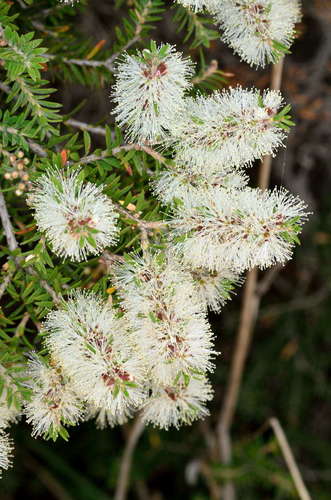
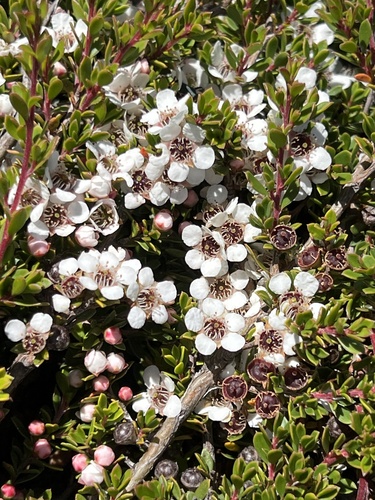
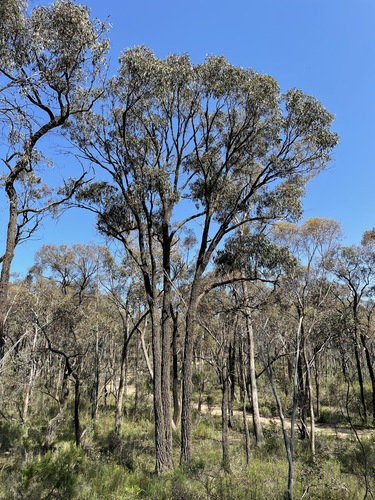
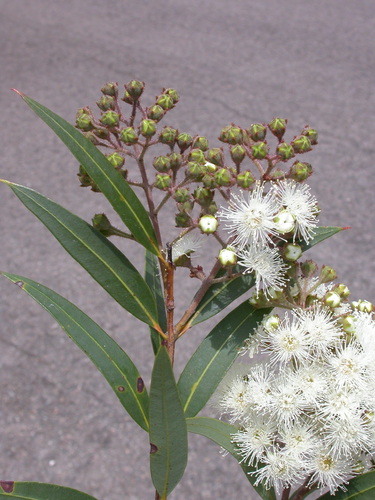
Angophora bakeri E.C.Hall is a tree that usually grows to 10–18 metres (33–59 feet) tall, and forms a lignotuber. Its trunk and branches are covered in rough, fibrous grey bark. Young plants and coppice regrowth have linear to narrow lance-shaped leaves that are more or less sessile. These juvenile leaves are 50–100 millimetres (2.0–3.9 inches) long, 4–10 millimetres (0.16–0.39 inches) wide, and arranged in opposite pairs. Adult leaves are thin, glossy green, paler on the lower surface, and also linear to narrow lance-shaped. They are 60–130 millimetres (2.4–5.1 inches) long, 5–10 millimetres (0.2–0.4 inches) wide, attached to a 3–10 millimetre (0.1–0.4 inch) long petiole, and arranged in opposite pairs. Flower buds grow at the ends of branchlets in groups of three or seven, borne on a 7–18 millimetre (0.3–0.7 inch) long peduncle, with individual buds on 4–11 millimetre (0.2–0.4 inch) long pedicels. Mature buds are 4–5 millimetres (0.16–0.20 inches) long and 4–6 millimetres (0.16–0.24 inches) wide. This species has five sepals that can reach up to 1 millimetre (0.04 inches) long, and petals that are around 3 millimetres (0.1 inches) long and wide. Flowering occurs between December and February, and the flowers are white or creamy white. The fruit is a pale brown or grey capsule, oval to cylindrical in shape, 8–10 millimetres (0.3–0.4 inches) long and wide, with ribs along its sides. This species, commonly called narrow-leaved apple, grows in sandy soil over sandstone. It is widespread and locally abundant from Port Stephens to Nowra, and extends as far west as Katoomba. A separate disjunct population, previously classified as the separate species Angophora exul, now a synonym of A. bakeri subsp. bakeri, occurs in Gibraltar Range National Park.