About Angelica dahurica (Hoffm.) Benth. & Hook.fil. ex Franch. & Sav.
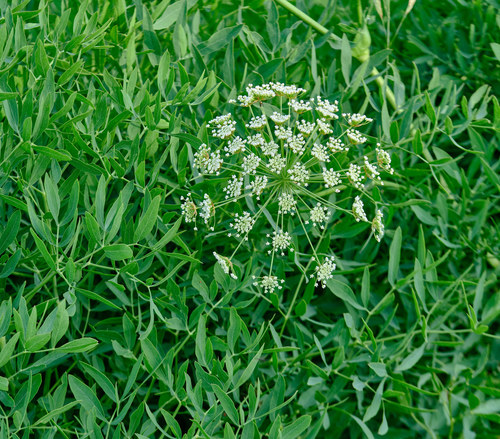
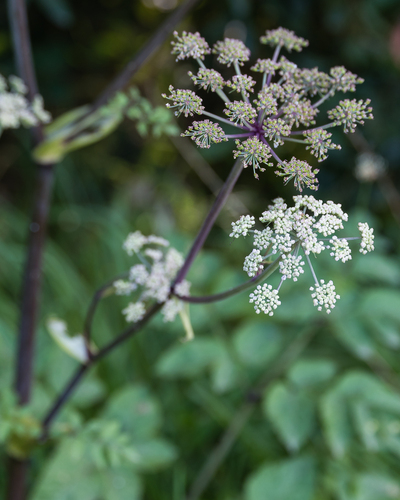
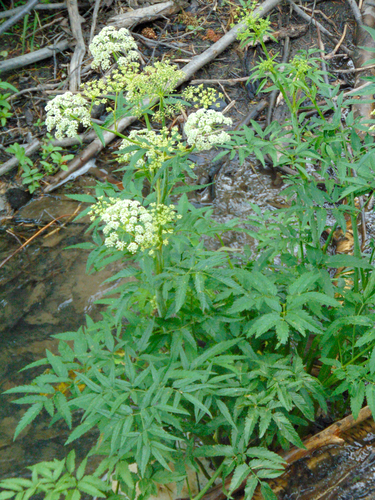
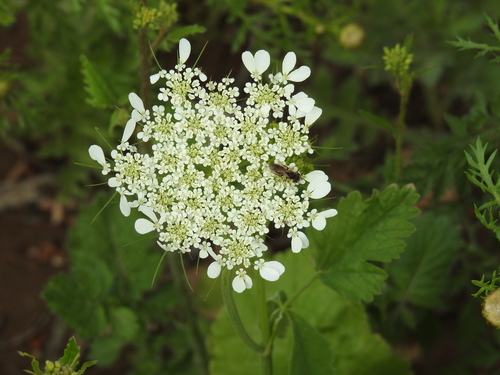
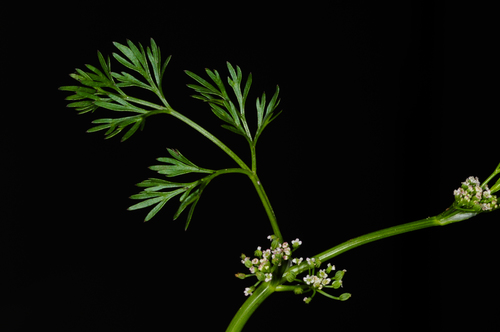
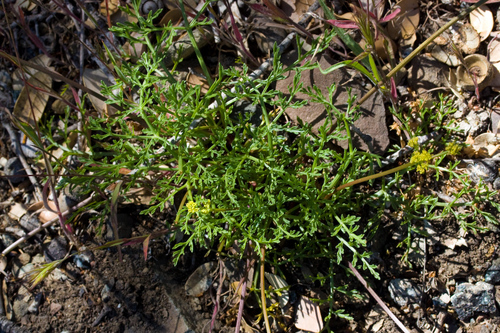
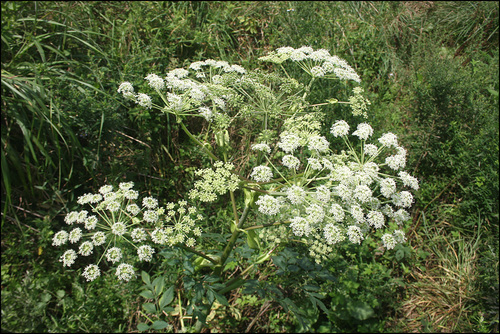
Angelica dahurica (Hoffm.) Benth. & Hook.fil. ex Franch. & Sav. is a perennial plant that grows between 1 and 2 meters (3 ft 3 in – 6 ft 7 in) tall. It usually produces a brown cylindrical root that is roughly 2 to 5 cm (0.8–2 in) thick. Its stem is purplish-green, ribbed, and normally 2 to 8 cm (0.8–3 in) thick in diameter. First year plants stay in a basal clump 30 to 50 cm (10–20 in) high, growing fuller in rich soil. These young plants have complex divided leaves 30 to 50 cm (10–20 in) long, with reddish-purple coloring at the base. In their second or third year, plants grow a sturdy, hollow stalk that reaches 2 m (6 ft 7 in) tall and is around 3 cm (1 in) in diameter. It produces greenish-white flowers arranged in umbels that can grow up to 30 cm (12 in) in diameter; these flowers bloom in summer, typically from July to September. After flowering, the plant produces seeds that shift from greenish-white to medium brown and become papery as they ripen from August to October. The flowers are hermaphroditic, meaning they contain both male and female reproductive organs. They are pollinated by insects, and the plant can also self-pollinate. The roots and leaves of this plant are strongly aromatic. The roots have a scent similar to that of wild carrots (Daucus carota), and a pungent, bitter taste. Along with its medicinal properties, this species contains furocoumarins, which increase skin sensitivity to sunlight and may cause dermatitis. Another compound found in its root is angelicotoxin, an active ingredient that has an excitatory effect on the body’s respiratory system, central nervous system, and vasculomotor system. It increases respiration rate, blood pressure, and saliva production, decreases pulse rate, and induces vomiting. In large doses, this toxin can cause convulsions and paralysis. Dahurican roots are harvested twice per year, in summer and autumn. The cylindrical roots must be harvested before the plant’s stalk emerges. After harvesting, leaves are removed, side roots are trimmed, and the roots are cut into thin longitudinal slices. The sliced roots are then dried in the sun. In Suining, 70% of the plant’s overall use is for general purposes, while 100% of its root use is for medicinal purposes. This plant is harvested and cultivated in Taiwan, Japan, and Korea as well. Medicinal use of the Dahurican root in China dates back to as early as 400 BC. Zhang Cong Zhen (1156–1228), a famous military physician, believed diseases were caused by external evil factors or pathogens that entered the human body, and he listed Bai Zhi (Angelica dahurica) as an herb that purges the body of negative influences such as heat, clamminess, dryness, and cold on the skin. Today, the roots are used to treat a wide range of conditions including headaches, nasal obstruction, swollen gums, and toothaches; they are also used for blood detoxification, as a pain reliever, anti-inflammatory, laxative, sedative, and as an anti-fungal skin treatment. Other uses of the plant include using its stalks as a food ingredient, for example as a seasoning for pig trotters in Chinese cuisine. Its stems have been made into decorative items. Its seeds are often used as a food seasoning and as a flavoring for liqueur. The herb is also a common ingredient in cosmetic products.