About Angelica archangelica L.
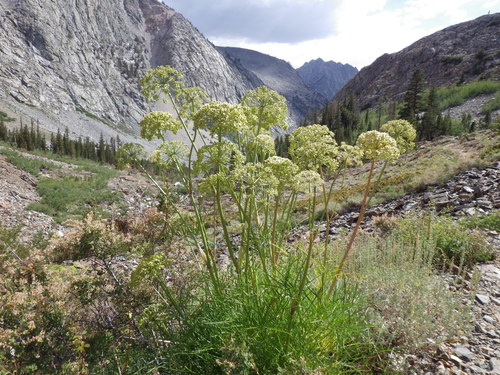
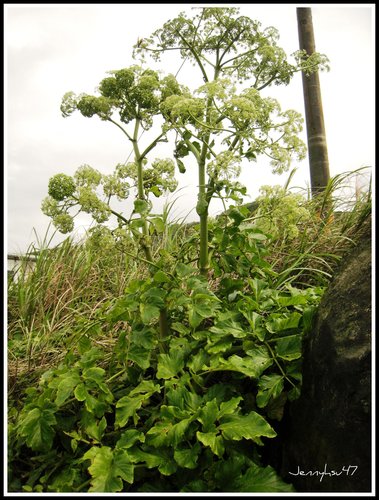
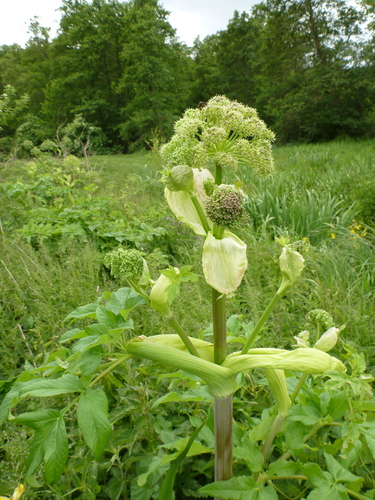
Angelica archangelica L. has a two-year growth cycle: in its first year, it only produces leaves, and in its second year, it develops a fluted stem that can grow up to 2.5 meters (just over 8 feet) tall. Its root is used in flavoring preparations. Its leaves are made up of many small leaflets arranged into three main groups, and each main group is further split into three smaller groups. The edges of the leaflets are finely toothed or serrated. The plant blooms in July, producing many small yellowish or greenish flowers clustered into large, round umbels. These umbels later produce pale yellow, oblong fruits. Angelica archangelica only grows in damp soil, and prefers locations near rivers or other bodies of water. It grows wild in Russia, Finland, Sweden, Norway, Denmark, Greenland, the Faroe Islands, and Iceland, and is mostly found in the northern parts of these countries. It is cultivated in France, primarily in Marais Poitevin, a marsh region near Niort in the Deux-Sèvres department. Commercially available angelica is often sourced from Hungary, Romania, Bulgaria, Germany and Poland. Starting from the 10th century, angelica was cultivated as a vegetable and medicinal plant. It became popular in Scandinavia in the 12th century, and sees particular use in Sámi culture, where it was historically used as a cooking herb under the name kvanne. It is used to add flavor to liqueurs or aquavits, such as Chartreuse, Bénédictine, Vermouth, and Dubonnet, as well as to omelettes, trout, and jam. The long bright-green stems can be candied and used as food decoration. Among plants in the Umbelliferae family, Angelica archangelica is unique for its strong pervasive aromatic scent, a pleasant perfume that is entirely different from the scents of fennel, parsley, anise, caraway, or chervil. Its scent has been compared to musk and to juniper. The roots of Angelica archangelica are among the most common botanicals used in gin distillation. They are often used alongside juniper berries and coriander to create gin's key aromatic profile. The roots are also used in absinthes, aquavits, and bitters. The hollow stems of Angelica archangelica are edible. After removing all leaves, stems are crystallized in sugar syrup and dyed green to use as cake decoration or as candy.