About Anemone L.
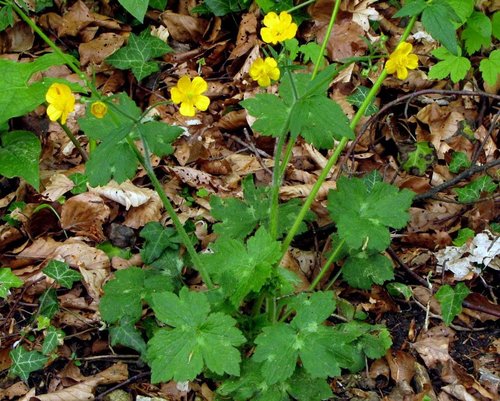
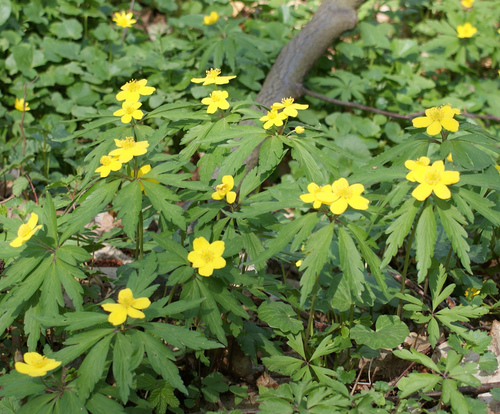
This herbaceous plant grows 5–15 centimetres (2.0–5.9 in) tall, and dies back down to its root-like rhizomes by mid summer. Its rhizomes spread just below the soil surface and multiply quickly, which helps the plant spread rapidly in woodland conditions. The flower measures approximately 1.5 centimetres (0.59 in) in diameter, and has five to eight petal-like segments (actually tepals) that are a rich yellow colour. Within its native range, this species flowers between March and May. The native range of this species (Anemonoides ranunculoides, under the genus Anemone L.) extends across Continental Europe to southwest Siberia, reaching as far south as the Caucasus Mountains in Turkey. The species has been introduced into Great Britain and other locations, with a naturalized population present at a well-known site in Quebec, Canada. This plant is widely cultivated as a garden plant, and is especially popular among rock garden and alpine garden enthusiasts. It has been awarded the Award of Garden Merit (AGM) by the Royal Horticultural Society. The Royal Horticultural Society classifies it as H4, meaning it is hardy throughout the British Isles. The double-flowered cultivar 'Pleniflora', which is sometimes listed as 'Flore Pleno', has also received this award. The larger-growing, more robust cultivar 'Frank Waley' is sometimes available for cultivation, along with the miniature subspecies A. ranunculoides subsp. wockeana and the selected form 'Laciniata', which has finely divided leaves.