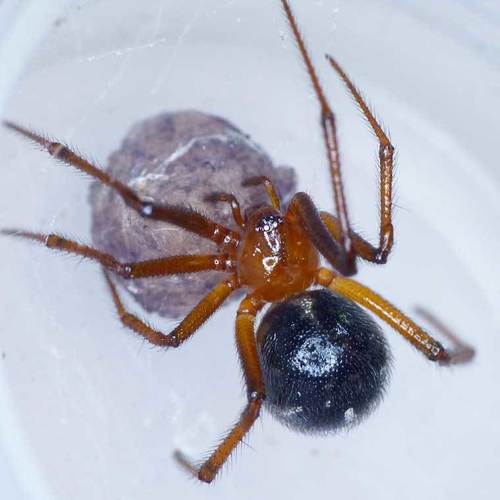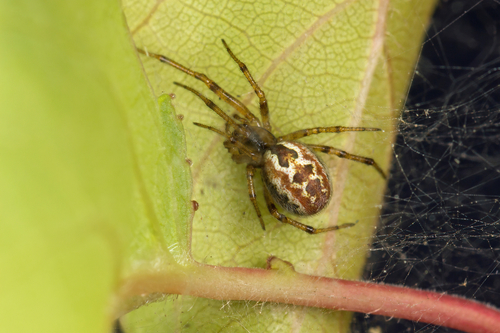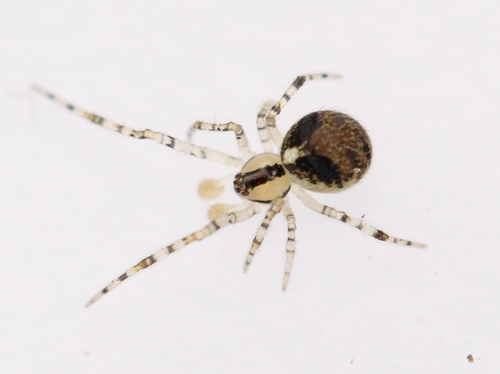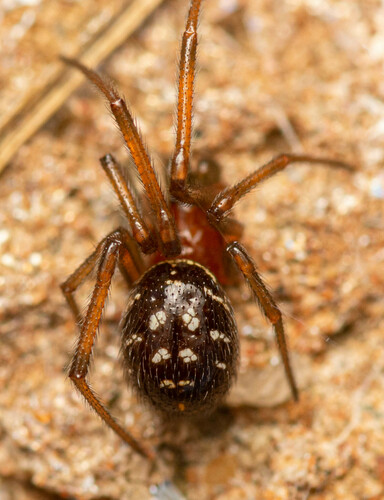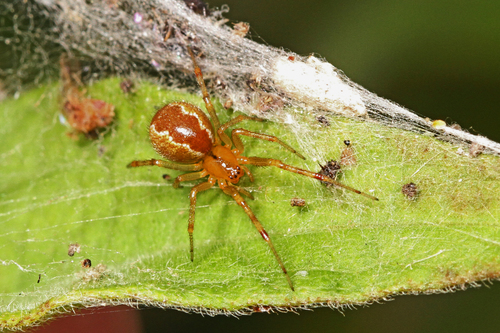
About Anelosimus studiosus (Hentz, 1850)
Anelosimus studiosus (Hentz, 1850) is a subsocial tangle web theridiid spider, belonging to the comb-footed spider family Theridiidae. It occurs across much of North America and South America, and inhabits both tropical and temperate regions. In 2012, genetic analysis confirmed that the previously recognized species A. tungurahua is actually the same species as A. studiosus.
This species shows social polymorphism, with two distinct behavioral phenotypes: social spiders that live communally, and asocial solitary spiders. Social spiders share a common living space, and divide brood care and prey capture duties. Asocial spiders live entirely alone, and will attack other female spiders that enter their nesting territory.
Populations with the social phenotype are generally not found below 30˚ latitude, and this phenotype becomes more common further north. Studies suggest the link between higher frequency of the social phenotype and colder temperatures stems from lower maternal survival rates and delayed juvenile development in colder conditions. It is hypothesized that sociality evolved in A. studiosus to reduce fitness costs for offspring if their mother dies before the brood is ready to disperse and survive independently. Despite their substantial behavioral differences, social and asocial A. studiosus readily interbreed and produce viable offspring.
Research on genetic relatedness in this socially polymorphic spider shows that social spiders in any given nest are more closely related genetically than asocial spiders. These findings indicate that social spiders have shorter dispersal distances than asocial spiders. Genetically closely related social spiders gain a fitness advantage by staying near the nest and cooperating with their relatives.
While the social phenotype can boost offspring survival in the short term, research indicates it may bring long-term fitness consequences. Evolving the social phenotype eventually leads to reduced aggression, so social spiders are less likely to fend off predators than asocial individuals. Social spiders can produce more young in a shorter time than asocial spiders, but when predators are present, social spider nests experience high predation rates. This pattern has been suggested to potentially cause the extinction of large A. studiosus populations.