About Andropogon gerardi Vitman
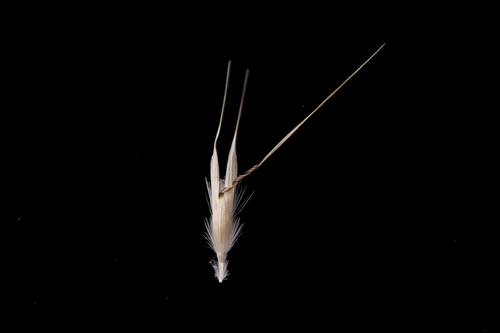
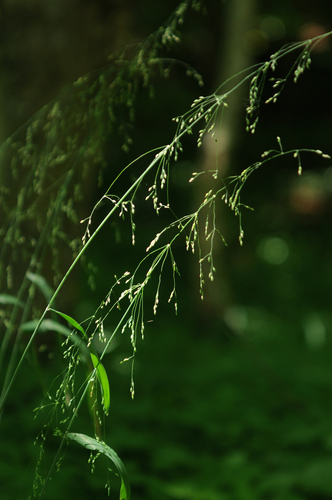
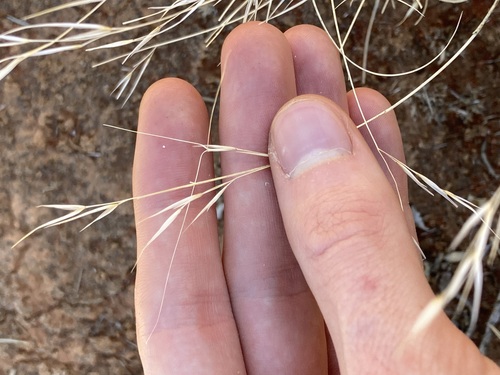
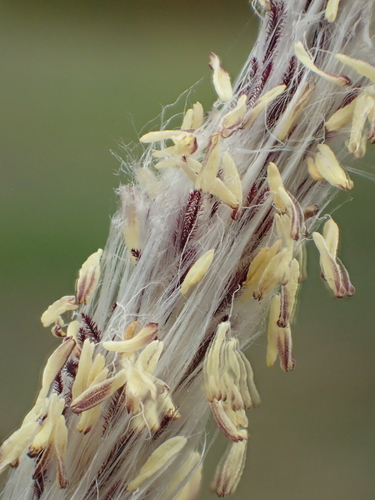
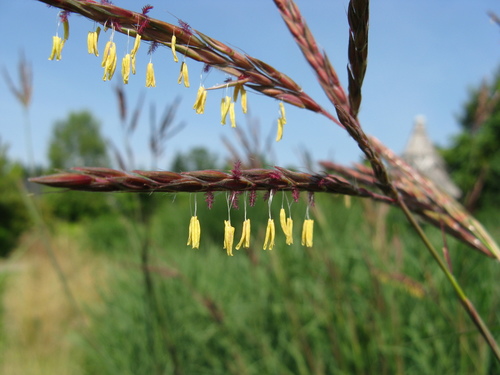
Andropogon gerardi Vitman, commonly known as big bluestem, is a perennial warm-season bunchgrass. It tolerates a wide range of soil conditions. Its main roots grow 1.8–3.0 m (6–10 ft) deep, and the plants produce strong, tough rhizomes that allow it to form very dense, strong sod. Growth height ranges from 1–3 m (3.3–9.8 ft), depending on local soil and moisture conditions. As the plant matures, its stem base develops a blue or purple color. Big bluestem blooms during the summer and produces seeds in the fall. Its inflorescence, the cluster of flowers, is made up of two to six (most commonly three) narrow, spike-shaped racemes arranged alternately along the top of the stem. This structure somewhat resembles a wild turkey's foot. Each raceme holds pairs of spikelets: one stalked spikelet, and a second stalkless spikelet at the base of the stalk. The stalkless spikelet usually contains a fertile, perfect floret (with both female and male reproductive parts) and a bristle-like awn, while the stalked spikelet has no awn and is either sterile or bears a staminate (male) flower. In prairie and other grassland ecosystems, big bluestem is a mid-successional grass. It grows in tall, dense stands that can outcompete other plant species, and these stands continue spreading until a disturbance stops their growth. It cannot tolerate shade and is adapted to survive fire. It acts as a host plant for the larvae of multiple butterfly species, including the arogos skipper, byssus skipper, cobweb skipper, common wood nymph, Delaware skipper, and dusted skipper. Larvae of the leaf beetle Diabrotica cristata feed on big bluestem roots, while adult beetles visit the flowers of other prairie plant species. Many ant species, including Formica glacialis, F. montana, and F. subsericea, decorate their nests with big bluestem seeds. Multiple ant species, including those three Formica species plus Lasius minutus and L. umbratus, build nests around the base of big bluestem bunchgrasses, forming large soil mounds. Larger mounds are shared by multiple ant species, a structure compared to an apartment complex where each species occupies its own nest partition. In the Chicago region, up to 12 ant species have been recorded living in a single mound. The rust fungus Puccinia andropogonis forms black telia on big bluestem leaves. Big bluestem and its variants make good forage for horses and cattle, and can also be cut to make hay. This grass is high in protein. Though it is not considered the highest quality native forage in the United States, it has long been recognized as a desirable and ecologically important grass by cattle ranchers and rangeland ecologists. Specialty plant nurseries cultivate big bluestem for its drought tolerance and status as a North American native grass. It is commonly grown for wildlife gardens, natural landscaping, and grassland habitat restoration projects. Because of its high biomass production, big bluestem is being evaluated as a potential feedstock for ethanol production.