About Andricus kollari (Hartig, 1843)
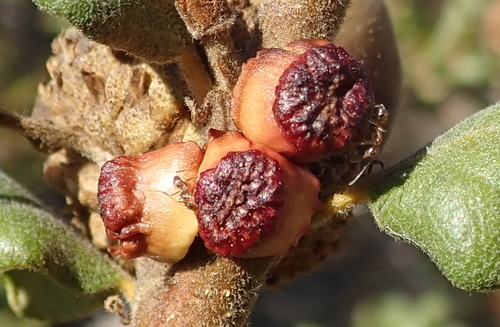
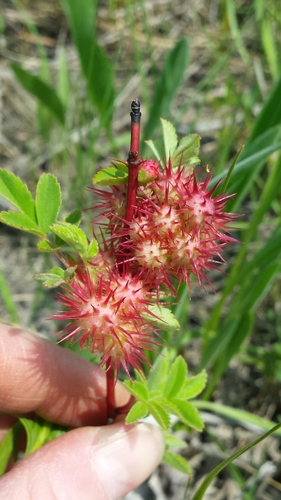
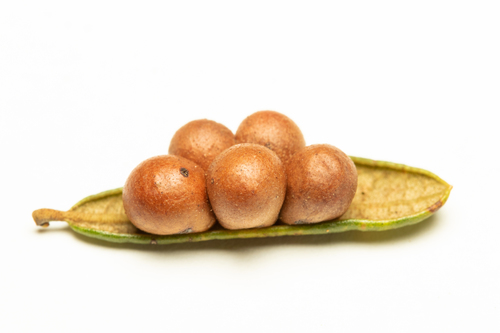
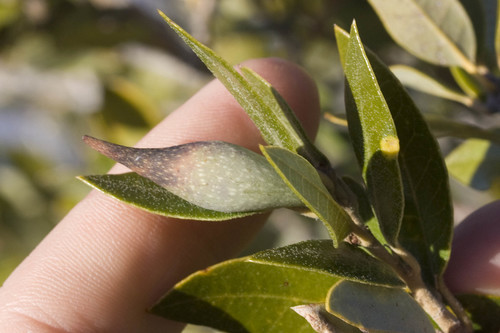
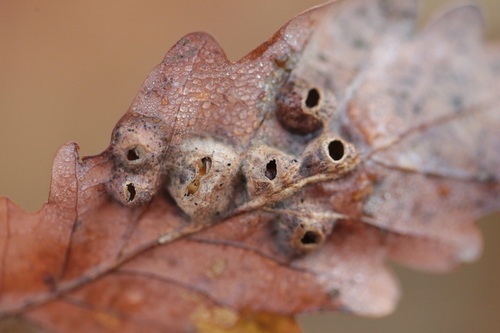
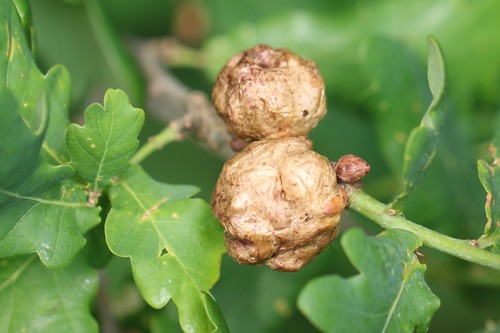
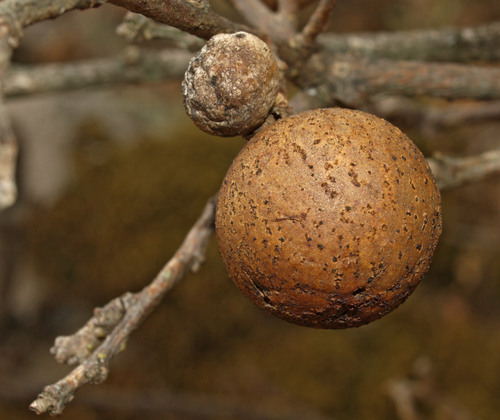
Adult Andricus kollari are dark brown, measuring between 1.5 and 2.0 millimetres (0.059–0.079 inches) in length. This species alternates between sexual and asexual generations, and each generation often takes two years to complete. Like all gall wasps, A. kollari causes parasitic galls to form on host trees, where it lays its larvae. In May or June, sexual females lay their eggs in the developing buds of susceptible oak trees using their ovipositor. Chemicals produced by both adult wasps and developing wasp larvae trigger gall formation. Three oak taxa are known to host this wasp: pedunculate oak (Quercus robur), sessile oak (Quercus petraea), and the hybrid Quercus × rosacea. Galls are most commonly found on immature or retarded host tree specimens, and are much rarer on older, healthier trees. Turkey oak (Quercus cerris), introduced into Britain in 1735, is required for A. kollari to complete its full life cycle. The galls caused by this species, called oak marble galls, are often confused with oak apple galls caused by a different gall wasp, Biorhiza pallida. Oak marble galls also have other common names: bullet gall, oak nut, and Devonshire gall. The developing spherical galls are green when young, turn brown as they mature, and reach full development in August. Each gall holds a single central chamber that contains one asexual generation female wasp larva. This larva develops into an adult winged gall wasp that emerges through a woodworm-like hole in September. The emerged asexual (agamic) females lay unfertilized eggs in the embryonic bud leaves of Turkey oak. Galls from these eggs develop slowly over the winter, and become visible as small oval structures between bud scales in March and April, resembling ant eggs or ant pupae. Adult gall wasps of the sexual generation emerge in spring, and include both males and females. These adults fly to common oaks to start the formation of summer marble galls. The abnormal host buds develop through the summer, and the entire bud is replaced by the growing gall. Marble galls can stay attached to their host tree for several years. The severity of A. kollari infestation varies significantly from year to year. A. hispanicus was previously classified within A. kollari, but the two species are genetically distinct and require different hosts to complete their life cycles. The sexual generation of A. hispanicus develops on cork oak (Quercus suber) rather than Turkey oak (Quercus cerris).
Oak marble galls contain large amounts of tannic acid, which was historically used to make iron gall ink and dye cloth. Recent research has found traces of iron-gall ink on the Dead Sea Scrolls and the 'lost' Gospel of Judas. Iron-gall ink was used for up to 1,800 years, but it does not age well. Over centuries, the ink fades, and it also discolours and damages paper. Better-performing waterproof ink formulas suitable for writing on paper became widely available in the 20th century. Today, iron gall ink is produced mainly by artists interested in reviving traditional methods, and potentially by forgers of old documents. Oak marble galls collected in Britain only contain around 17% tannic acid, which is too little to produce the best results; Aleppo galls contain three times this amount of tannic acid. A traditional folk remedy claims powdered oak marble galls mixed with hog's lard, applied to the posterior, cures piles. Oak marble gall extract is currently used in deodorants, due to the anti-bacterial properties of tannic acid.