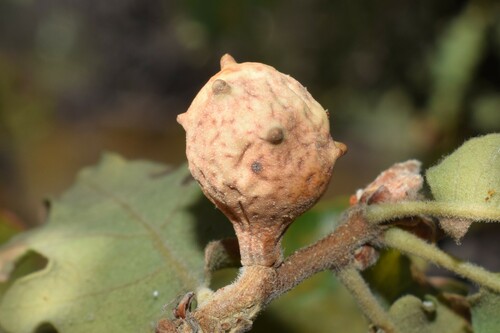
About Andricus infectorius (Hartig, 1843)
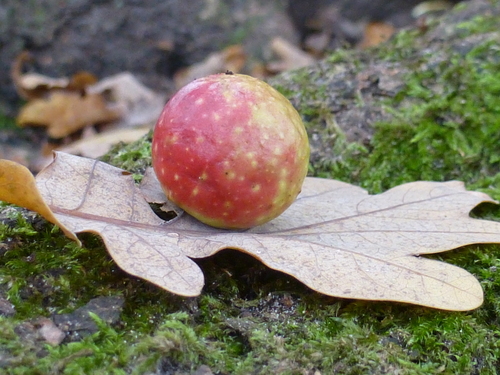
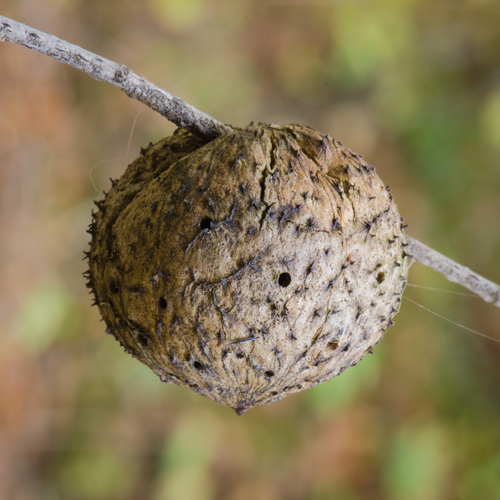
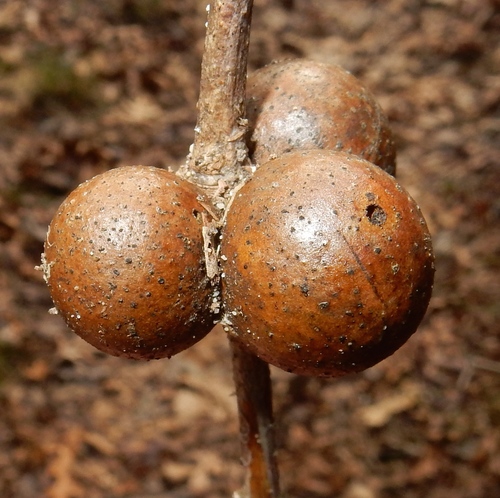
Description of the gall produced by Andricus infectorius: The asexual generation produces a spherical gall that measures 10 to 20 mm across. This gall develops on the terminal bud of an oak branch, and can be found from late May through October, when it reaches maturity. It is initially green, then darkens to dark brown as it matures, and falls to the ground during winter. This gall occurs on four oak species: Hungarian oak (Quercus frainetto), sessile oak (Quercus petraea), downy oak (Quercus pubescens), and pedunculate oak (Quercus robur). Oak gall wasps typically have two generations per life cycle: one sexual and one asexual, each producing a distinct type of gall. According to Milan Zúbrik et al. (2013), the gall produced by the sexual generation of Andricus infectorius is currently unknown, but it likely develops on Turkey oak (Quercus cerris). A very small, ovoid gall that grows on Turkey oak catkins may be the sexual generation gall of this species. Distribution: This species has been recorded in several western and central European countries, but it is absent from Belgium, Germany, Spain, and Switzerland. It has recently been detected in Great Britain. A gall collected in 2013 at Trengwainton Carn, near Penzance, Cornwall, was originally identified as Andricus inflator. According to Dr C Leach of the British Plant Gall Society, this gall is more likely to be Andricus infectorius.