About Andricus foecundatrix (Hartig, 1840)
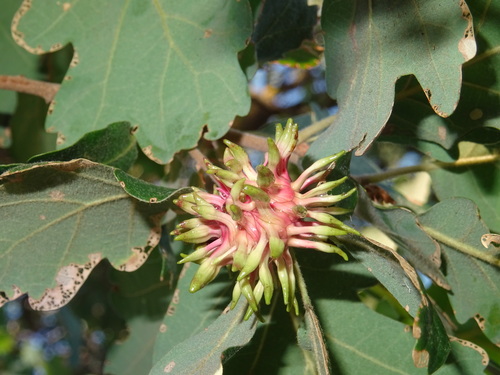
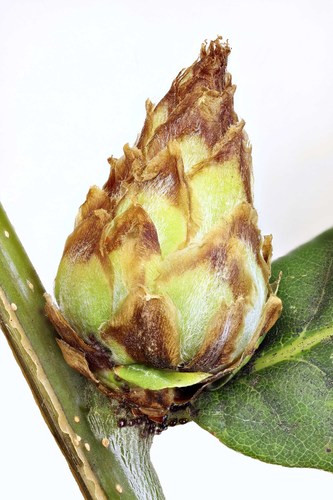
Andricus foecundatrix (Hartig, 1840), formerly known as Andricus fecundator, is a parthenogenetic gall wasp. This species uses its ovipositor to lay a single egg inside a leaf bud, which induces the formation of a gall called an oak artichoke gall, oak hop gall, larch-cone gall, or hop strobile. The gall develops as a chemically-caused distortion of axillary or terminal leaf buds on pedunculate oak (Quercus robur) or sessile oak (Quercus petraea) trees. The wasp larva lives inside a smaller hard casing within the gall, and this structure is released in autumn. The asexual adult wasp emerges the following spring and lays its eggs in oak catkins. These eggs lead to the development of small oval galls that produce the sexual generation of the wasp. An unrelated gall called a yew artichoke gall is caused by the fly Taxomyia taxi, and it does not occur on oaks like the gall formed by this species. Previous scientific synonyms for this species include A. fecundator, A. fecundatrix, A. pilosus, A. gemmarum, A. gemmae, A. gemmaequercus, A. gemmaecinaraeformis, and A. quercusgemmae; the current accepted scientific name is Andricus foecundatrix. All wasps that emerge from oak artichoke galls are female. These females each lay one egg in the male flowers of oaks, which stimulates the formation of small galls called hairy catkin galls. Adult wasps of both sexes emerge from these catkin galls. After mating, these wasps lay eggs in oak buds to start the life cycle over again. After an oak artichoke gall falls to the ground, the adult imago may leave the gall the following spring, or it may delay emergence for 2 to 3 years. Old galls can persist, with opened scales that curve outward.