About Andrena clarkella (Kirby, 1802)
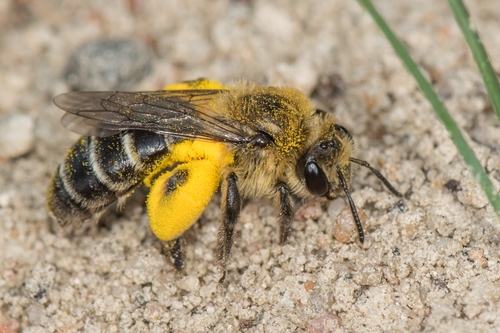
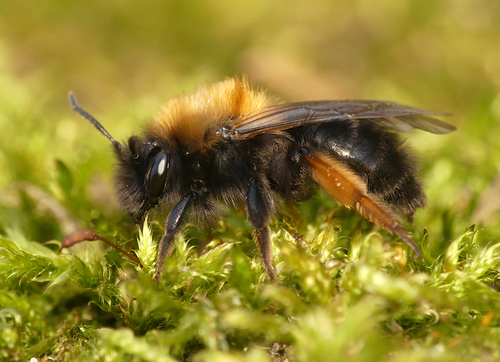
The Clark's miner bee, scientifically known as Andrena clarkella, is a species of miner bee in the family Andrenidae. Its other common names are Clark's andrena and Clarke's mining bee. This species occurs in Europe, Northern Asia excluding China, and North America. The species epithet clarkella was coined by Kirby to honor Bracy Clark, an English entomologist. Adult Andrena clarkella reach 10–13 mm in body length. Males have brown hair with loose tergite bands; they are rarely found on flowers, and more often observed basking on tree bark. In the field, males cannot be distinguished from similar Andrena species. Females can be readily identified in the field: they are very densely hairy, with black hairs on the abdomen and reddish brown hair on the mesonotum. Their hind legs are fox red, with an equally colored pollen brush. The terminal abdominal fringe is dark brown, and small female specimens resemble Andrena bicolor. Andrena clarkella is oligolectic, collecting pollen only from willows in the genus Salix, family Salicaceae. This bee nests in bare to sparsely overgrown areas located in sparse forests, forest fringes, or clearings. It prefers to nest in sandy soil, but will also use humus soils. Nests are typically found in smaller aggregations with low nest density. The nest entrance is locked before the bee departs on each food supply flight. Each nest contains one to four brood cells, located on average 5 cm below the surface, to a maximum depth of 30 cm. Andrena clarkella has a strong affinity for forest habitats, including forest fringes, forest clearings, and clear cuts, and prefers areas with sandy soil. Its range extends from lowland areas up to subalpine altitudes. Known parasites of Andrena clarkella include the cuckoo bee Nomada leucophthalma, and the nest parasite Bombylius major. Adult bees are sometimes infested by Stylops melittae. This species has one generation per year, with an adult flight period from early March to mid-May.